Mapping the Landscape of Higher Education in New York State Prisons
This report examines both the history and scope of college in prison programs across New York State. This report also describes the existing programs and incorporates the perspectives of DOCCS officials, college administrators, and incarcerated students.
Second Chance Pell Experimental Sites Initiative Update
This fact sheet provides an update on outcomes—including expanding enrollment, course offerings, and degrees awarded—from the Second Chance Pell Experimental Sites Initiative. The initiative, launched by the U.S. Department of Education in 2015, provides need-based Pell Grants to people in state and federal prisons through partnerships with 65 colleges in 27 states. The Vera Institute of Justice has provided technical assistance to the participating colleges and corrections departments, helping to ensure that these programs are providing quality higher education both in prison and post-release.
College After Prison: A Review of the Literature on Barriers and Supports to Postsecondary Education for Formerly Incarcerated College Students
This report synthesizes existing literature around higher education for formerly incarcerated individuals and describes the need for more work in this area. More than 650,000 individuals are released from state and federal prisons and return to the community each year. However, most programming and research have been concentrated on correctional education. As a result, formerly incarcerated individuals are largely not recognized as a student group needing support, programming, and research in the higher education space.
Eligibility Requirements for Students Confined in an Adult Correctional or Juvenile Justice Facility
This fact sheet from the U.S. Department of Education's Federal Student Aid office explains eligibility requirements for incarcerated students.
Reflections on Building a Partnership With Corrections
This guide is part of an effort to provide college providers with the necessary tools for developing programs that are responsive to the unique environment of correctional facilities. While designed specifically for college programs that operate in New York State Department of Corrections and Community Supervision facilities, this guide may also be useful for organizations and colleges outside of New York that wish to establish or enhance college in prison programs.
Back to School: A Guide to Continuing Your Education After Prison
This guide is designed to help students take the first steps towards continuing their education, whether that means learning English, working towards their HSE, learning an occupation, or building on college credits they have already earned.
Second Chance Pell: A Snapshot of the First Three Years
The Second Chance Pell Experimental Sites Initiative, launched by the U.S. Department of Education in 2015, provides need-based Pell Grants to people in state and federal prisons. Second Chance Pell has active partnerships with 64 colleges that teach in 28 states. The schools were selected in June 2016 for the initiative, which examines whether expanding access to financial aid increases incarcerated adults’ participation in educational opportunities. The Vera Institute of Justice (Vera) is providing technical assistance to the participating colleges and corrections departments, helping to ensure that the programs provide quality higher education in prison and post-release. This policy brief summarizes survey data that 60 of the participating colleges submitted to Vera about the first three years of the project.
The Impacts of College Education in Prison: An Analysis of the College-in-Prison Reentry Initiative
Access to education is in high demand among the incarcerated population. There are clear benefits to students who are incarcerated, their families and communities, public safety, and safety inside prisons. Yet the gap in educational aspirations and participation has been largely driven by a lack of capacity due to limited funding.
The Manhattan District Attorney’s Criminal Justice Investment Initiative funded the College-in-Prison Reentry Initiative (CIP) to close this gap by expanding access to college education in prisons throughout New York State. This fact sheet unpacks the impact of participation in degree programs offered by seven colleges participating in CIP and reveal the effects that college in prison can have on in-facility behavior, recidivism, employment, and income after release.
The Impacts of College-in-Prison Participation on Safety and Employment in New York State: An Analysis of College Students Funded by the Criminal Justice Investment Initiative
Access to education is in high demand among the incarcerated population. There are clear benefits to students who are incarcerated, their families and communities, public safety, and safety inside prisons. Yet the gap in educational aspirations and participation has been largely driven by a lack of capacity due to limited funding.
The Manhattan District Attorney’s Criminal Justice Investment Initiative funded the College-in-Prison Reentry Initiative (CIP) to close this gap by expanding access to college education in prisons throughout New York State. In this report, Vera Institute of Justice (Vera) researchers unpack the impact of participation in degree programs offered by seven colleges participating in CIP and reveal the effects that college in prison can have on in-facility behavior, recidivism, employment, and income after release. Vera additionally presents a cost analysis of program delivery and potential expansion, in order to better understand the potential return on investment of such initiatives.
Guide to Federal Student Aid for Students With Criminal Records
This fact sheet from the U.S. Department of Education's Federal Student Aid office provides answers to common questions from incarcerated students seeking financial aid.
How State Higher Ed Leaders Are Expanding College in Prison
This story from Margaret diZerega, Initiative Director for the Vera Institute of Justice's Center for Sentencing and Corrections and Unlocking Potential, and Hannah Eddy, Communications Manager for Unlocking Potential, discusses the "closed doors" many individuals with a criminal record face in pursuing postsecondary education, and highlights the forthcoming reinstatement of federal need-based financial aid—or Pell Grants—for people in prison as a solution with the potential to open many doors come July 1, 2023.
As the story explores, across the United States, education and corrections leaders are preparing for a wave of new colleges, particularly four-year universities, to launch programs in prisons. The authors discuss the fact that, anticipating this new opportunity to expand access, states like Colorado and Tennessee have begun to bring together four-year and community colleges, departments of corrections, education-focused nonprofits, and—for the first time—state departments of higher education to foster communication among these partners, improve collaboration, and begin creating more effective state systems for higher education in prisons.
Second Chance Act Reentry Education and Employment Fact Sheet
This fact sheet from the U.S. Department of Justice's Bureau of Justice Assistance provides information on the following three current Second Chance Act investments that support education and employment reentry strategies in 28 states and jurisdictions: the FY 2018 Adult Reentry and Employment Strategic Planning Program (ARES); the FY 2020 Correctional Adult Reentry Education, Employment, and Recidivism Reduction Strategies Program (CAREERRS); and the FY 2021 Adult Reentry Education, Employment, Treatment, and Recovery Program.
The fact sheet discusses eligibility, funding amounts, allowable use of funds, award periods, and highlights a grantee for each of the aforementioned Second Chance Act investments.
Fact Sheet on Changes to Protect Veterans, Students, and Taxpayers and Support Incarcerated Students
In October 2022, the U.S. Department of Education published final regulations for the federal Pell Grant program that promote accountability, expand college access to students who are incarcerated, and strengthen protection for veterans, service members, students, and borrowers.
This fact sheet includes additional details on the major provisions of the rule and changes made in response to public comment.
Fact Sheet: Bureau of Justice Assistance Programs That Support Corrections
This fact sheet was produced by the U.S. Department of Justice's Bureau of Justice Assistance (BJA) to provide information on BJA-funded programs that support corrections. This document belongs to a series of fact sheets that highlight BJA-funded programs that support different focuses.

Incarcerated Workers in the U.S are part of a hidden workforce linked to hundreds of popular food brands
AP's investigation reveals a hidden truth: U.S. prison labor fuels major food brands. From Frosted Flakes to Coca-Cola, products in our everyday supermarkets are linked to a multibillion-dollar empire built on the backs of currently incarcerated people, often working for little or no pay. Programs like the Education in Action initiative (EiA), are crucial to ensure that we are empowering workers on the inside - through educational opportunities and fair work experiences, let's challenge the possibilities of what's possible when we think about prisoner labor.

Today – January 31! Webinar on Financial Aid
TODAY! On January 31 from 2:00-3:15 ET, NASFAA (National Association of Student Financial Aid Administrators) will host a free and publicly available webinar. See below for a description and links to register.
Workshop: Completing the Paper 24/25 FAFSA With Students Who Are Incarcerated
Financial aid advising is an essential component of Prison Education Programs (PEPs). Many PEPs rely on the paper FAFSA when serving students who are incarcerated. We expect many new Prison Education Programs (PEPs) will enroll their first students in the fall of 2024. The challenge of introducing PEP work at the same time as FAFSA Simplification implementation crescendos will create a challenge for financial aid staff as well as PEP administrators. During this workshop, we will walk through the FAFSA completion process, highlighting the most complex form and verification questions. We will also talk about the methods for processing those paper FAFSAs. Both financial aid teams and prison program administrators will join the conversation and welcome your questions.
The direct link for participants to register for the Completing the Paper 2024-25 FAFSA With Students Who Are Incarcerated Workshop is: https://event.on24.com/wcc/r/4463509/F1C5A03976B02902CA10C4A17A7FBAA1.
Individuals may also register from the NASFAA website as well: https://www.nasfaa.org/paper_fafsa_students_incarcerated_jan24
This work is generously funded by a grant from Ascendium Education Group.

Event: Mend Launch Party
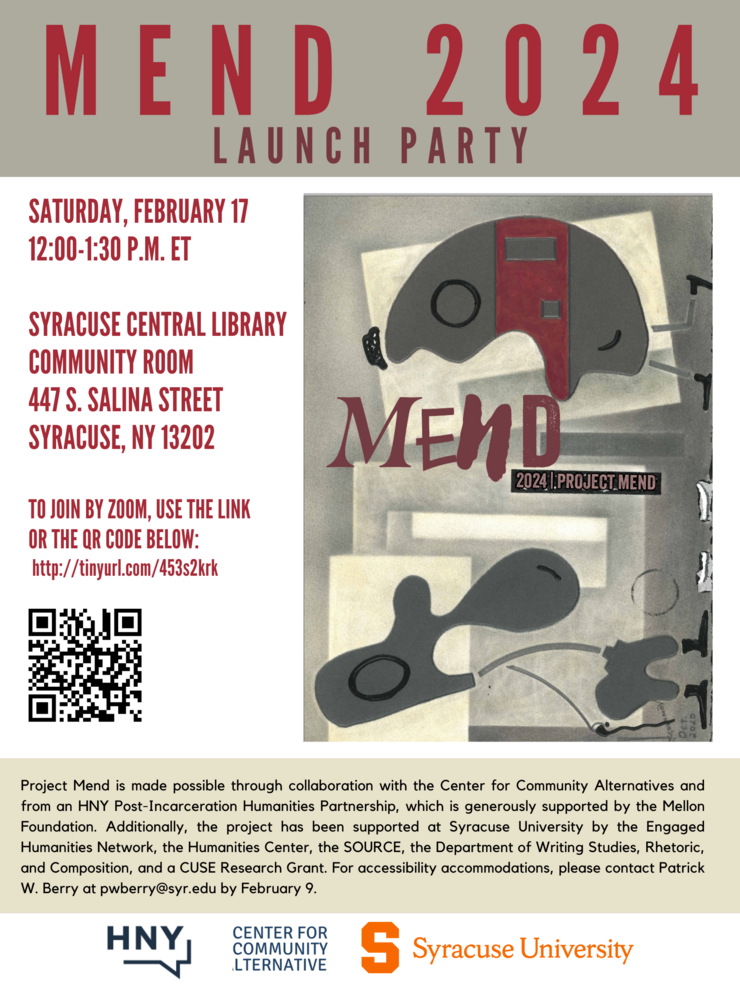
All—
As some of you know, we've been working on the second edition of Mend, a journal that celebrates the work of incarcerated and formerly incarcerated people and their families. It is also a publication created by justice-impacted people in Syracuse, New York.
Our launch party will take place on Saturday, February 17, at the Syracuse Central Library, from 12-1:30 p.m. ET and on Zoom. Please consider joining us. The event is open to the public.
MEND JOURNAL LAUNCH PARTY
SATURDAY, FEBRUARY 17
12:00 p.m.-1:30 p.m. ET
SYRACUSE CENTRAL LIBRARY
COMMUNITY ROOM
447 S. Salina St., Syracuse, NY 13202
and on Zoom. You can register here: http://tinyurl.com/453s2krk
COMMUNITY…CREATIVITY…AND FOOD
The event will feature readings and recognitions of this year’s cohort.
Project Mend is made possible through collaboration with the Center for Community Alternatives and through an HNY Post-Incarceration Humanities Partnership, which is generously supported by the Mellon Foundation. Also, the project has been supported at Syracuse University by the Engaged Humanities Network, the Humanities Center, the SOURCE, the Department of Writing Studies, Rhetoric, and Composition, and a CUSE Research Grant. For accessibility accommodations, please contact Patrick W. Berry at pwberry@syr.edu by February 9.
—Patrick

Educational Justice: Maine State Prison's Cohort of MIT Computer Tech Courses
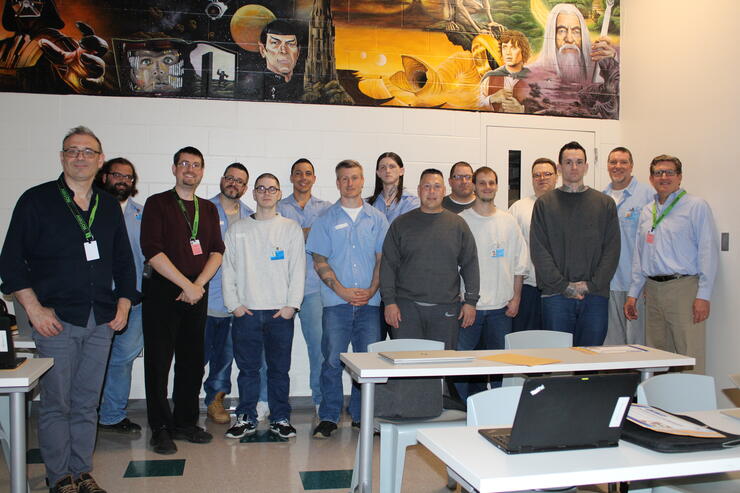
I am so proud of the men at Maine State Prison for completing and sustaining this computer technology program! This is exactly the type of programming and equality that prison education needs to normalize to offer incarcerated students tech savvy, marketable skills and to give equity to tech spaces for incarcerated people.
The Educational Justice Institute and RAISE at MIT have been faithfully offering web design, computer programming, and app invention classes for years, not only in Maine, but to mixed cohorts in facilities from various states.
In addition to the MIT App Inventor class, there have been several sessions of the BRAVE Behind Bars web-design and coding course for Women at Maine Correctional Center and the Southern Maine Women's Reentry Center, and Python coding courses, all of which are conducted by MIT graduate students in concert with The Educational Justice Institute.
Middle States Commission on Higher Education (MSCHE) Policy and Regulatory Guidance on Prison Education Programs
On October 28, 2022, the United States Department of Education published final regulations that provide a framework for how to implement Pell reinstatement and ensure high-quality postsecondary education in correctional facilities. The regulations will take effect on July 1, 2023. Specifically, the FAFSA Simplification Act, passed on December 27, 2020, restored Pell Grant eligibility for incarcerated students. Now, for the first time since the 1990s, people who are confined or incarcerated who are enrolled in an eligible prison education program (PEP) will be able to access federal financial assistance through the Pell Grant program. This document provides guidance on how students who are confined or incarcerated can access federal Pell Grants.
'It’s Useless, to Put It Politely': Experiences With Technology Among Incarcerated Students Receiving Second Chance Pell at Four Institutions
In this research brief, researchers share findings from incarcerated students and alumni regarding their experiences with technology during enrollment in postsecondary education and participation in Second Chance Pell.