The Opportunities in the Field group is a space where the field can discuss employment, work-learning, and volunteering opportunities, and HEP-related events.
Group Content

Call for Collaboration! Teaching and Learning in HEP Curriculum
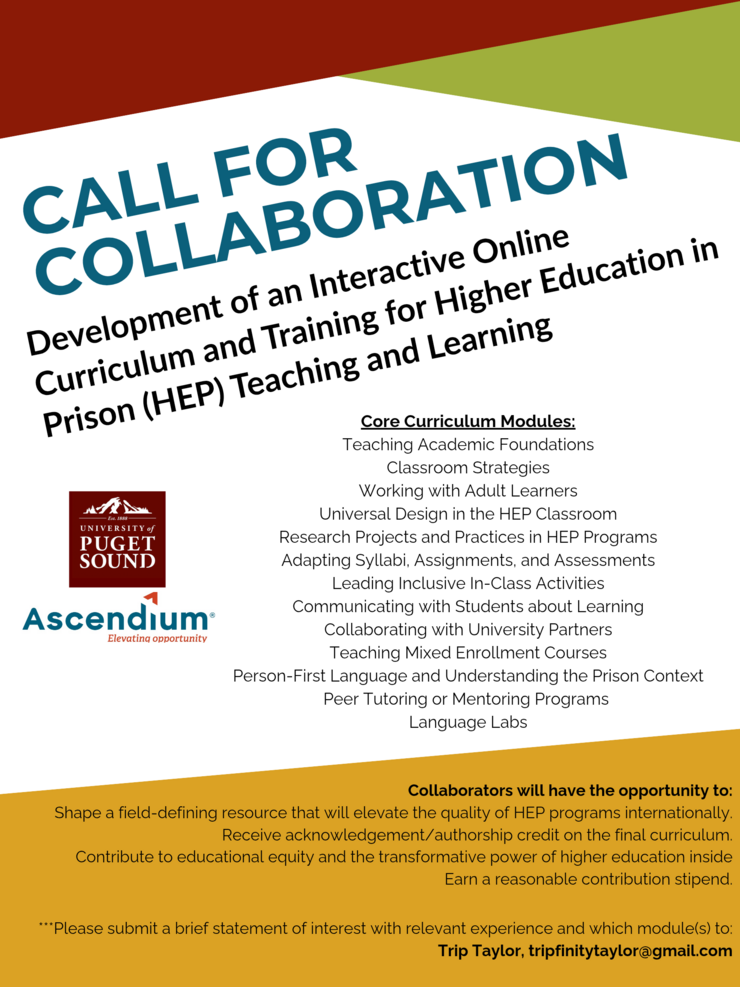
Call for Collaboration:
Development of an Interactive Online Curriculum and Training for Higher Education in Prison (HEP) Teaching and Learning
Who We Are:
Based out of the University of Puget Sound and led by Tanya Erzen, our project recently released the report "Bridging the Divide." This report shares several promising practices designed to help educators and administrators of HEP programs enhance services for their students. We had a dedicated team of 27 individuals, the majority of whom are directly impacted by the justice system, who came together to assess the current landscape of teaching and learning services within the Higher Education in Prison (HEP) field for the report.
The project is now expanding to formalize and implement some of these practices across the field. This next phase is being led by Dr. Erzen with two formerly incarcerated individuals who previously helped develop and lead prison education programs from the inside and are currently working outside in the field: Trip Taylor and Elizabeth Shatswell.
Introduction:
We are seeking passionate educators, instructional designers, scholars, and practitioners committed to excellence and equity in higher education in prison (HEP) programs to collaborate on the development of a comprehensive, interactive, living online curriculum for teaching and learning within prison settings. This crucial resource will equip current and future HEP instructors, university partners, and program staff with the specialized pedagogical knowledge, strategies, and cultural competence necessary to foster rigorous, engaging, and supportive learning environments for incarcerated students.
We are not seeking to reinvent the wheel here. We know that many amazing people on the ground throughout the field have already designed and created remarkable resources along these lines. Our goal is to bring together the resources already out there at individual facilities or programs to develop a robust, living curriculum that can be accessed and utilized by practitioners all over the world working in HEP programs.
This project aims to further bridge the gap between traditional higher education teaching methods and the unique needs, challenges, and opportunities presented by the prison classroom context and learners who have often faced systemic educational barriers.
We are inviting collaborators to join us in designing and developing the following core modules:
Core Curriculum Modules:
Teaching Academic Foundations: Strategies for explicitly teaching fundamental college-level skills, including reading and writing strategies, critical thinking, executive functioning, time management, organizational skills, and navigating the culture of higher education ("learning to be a college student").
Classroom Strategies: Culturally Responsive, Anti-Racist, Trauma-Informed: Developing classroom practices and content delivery that acknowledge and address issues of race, culture, systemic inequality, and the impact of trauma on learning and engagement.
Working with Adult Learners: Exploring principles of andragogy, motivation, prior knowledge, and life experience as assets in the HEP classroom, focusing on effective instructional strategies for adult student success.
Universal Design in the HEP Classroom: Applying Universal Design for Learning (UDL) principles to course design, materials, and instruction to maximize accessibility for all learners. This module will include a specific discussion of disability, accommodation, and access in the carceral context.
Research Projects and Practices in HEP Programs: Guidance on ethical considerations, constraints, and effective strategies for incorporating research methods, information literacy, and project-based learning into the prison classroom, including working with limited resources.
Adapting Syllabi, Assignments, and Assessments: Practical approaches to modifying standard college course materials, learning outcomes, and evaluation methods to be relevant, accessible, and fair within the constraints and realities of the prison environment. Includes low-or-no-tech modifications.
Leading Inclusive In-Class Activities: Techniques for facilitating engaging, equitable, and rigorous classroom interactions, including best practices for leading dynamic class discussions and structuring effective group work.
Communicating with Students about Learning: Strategies for providing constructive, growth-oriented feedback on student work and navigating communication barriers, privacy concerns, and administrative constraints in the HEP context.
Collaborating with University Partners: Best practices for integrating the essential support services of a university—including librarians/research librarians, writing centers, student support staff, and disability services—into HEP programs.
Teaching Mixed Enrollment Courses: Strategies for successfully managing classrooms that include both incarcerated students and non-incarcerated university students (where applicable), ensuring an inclusive and equitable experience for all.
Person-First Language and Understanding the Prison Context: Essential training on using respectful, non-stigmatizing language, understanding the operational and administrative realities of the correctional environment, and navigating security and policy requirements.
Peer Tutoring or Mentoring Programs: Useful tips or guidance on the development of peer tutoring or mentoring within HEP programs.
Language Labs: Innovative curriculum that harnesses immersive methods to transform how students master listening, speaking, reading, and writing skills while deepening their cultural understanding through authentic engagement.
Our Vision:
The final product will be a dynamic, interactive online curriculum and training utilizing multimedia resources, practical case studies, downloadable templates, and opportunities for reflective practice and peer learning. It will be designed for asynchronous access, catering to the schedules of busy educators and staff - but meant to be completed in cohorts for more interactive engagement.
We are seeking collaborators with expertise in:
Higher Education in Prison (HEP) program administration or teaching
Adaptive Instructional Design
Culturally Responsive and Anti-Racist Pedagogy
Trauma-Informed Practices in Education
Universal Design for Learning (UDL) and Disability Services
Adult Learning Theory (Andragogy)
Lived Experience
Benefits of Collaboration:
Collaborators will have the opportunity to:
Shape a field-defining resource that will elevate the quality of HEP programs internationally.
Receive acknowledgement/authorship credit on the final curriculum.
Contribute to educational equity and the transformative power of higher education for incarcerated individuals.
Earn a reasonable contribution stipend.
How to Express Interest:
To express your interest and receive a detailed outline of next steps, please submit a brief statement of interest (no more than 500 words) outlining your relevant experience and the module(s) you are most interested in contributing to tripfinitytaylor@gmail.com by Friday, December 19th, 2025.
We will schedule a Zoom call for mid to late January with those willing and able to contribute to discuss the path forward. We are excited to develop this essential resource with the community!

Employment opportunities at Community Education Project (mostly in-person, Central Florida)
Dear all,
we are hiring for three new positions in our program - Community Education Project (https://www.stetson.edu/other/cep/). They are all part-time and predominately in-person with more info in the corresponding links:
- Writing and research specialist: https://jobs.silkroad.com/Stetson/Careers/jobs/1473
- Academic Success Coordinator: https://jobs.silkroad.com/Stetson/Careers/jobs/1472
- Editor of in-house publications: this position is for a contractor with more info is available in the attachment.
Please apply or share with those who may be interested, and contact us at communityeducation@stetson.edu.
Thank you!



Applications for Cohort 2 of the Fellowship for Leaders in HEP now open!
Rockwood Leadership Institute, in partnership with Ascendium, is excited to announce that applications for the second cohort of the Fellowship for Leaders in Higher Education in Prison are now open! Full tuition and accommodations will be covered by Rockwood and fellows will receive a $5,000 stipend for completing the fellowship, along with $4,000 in training-related expense reimbursements.
For all the details, including the Fellowship programming and timeline, purpose, goals, and more, see our Applicant Program Information & FAQ.
Who can apply?
This Fellowship is for formerly incarcerated leaders working in the Higher Ed in Prison field. Leaders at non-profit organizations, Universities and colleges, government agencies, foundations, state coalitions, etc. are all welcome to apply.
This training is limited to 24 participants who:
- Are formerly incarcerated leaders or decision makers in the Higher Education in Prison field, preferably those with Higher Education programming experience while incarcerated;
- Demonstrate personal/professional readiness to step out of their comfort zone and learn new leadership skills;
- Contribute to creating a cohort that is diverse in terms of demographics (such as race, gender identity, and sexual orientation), geography, lived experiences, and organizational strategy;
- Commit to full participation in the year-long fellowship, including three in-person retreats, completing any required pre-session work and post-session evaluations.
When are the in-person sessions?
- Session 1: September 22-26, 2025, Wisconsin
- Session 2: December 1-5, 2025, California
- Session 3: March 16-20, 2026, New York
Fellows must be able to attend all three in-person sessions in order to participate.
Additional Program Offerings
- Virtual orientation prior to Session 1.
- Two virtual Community Calls will support participants’ relationship building and learning outside of the structured training session time.
- Two virtual Webinars will support participants in learning concrete skills.
- Individual professional coaching. Each participant will have access to up to four free coaching sessions with a Rockwood trainer during the program.
Applications will close May 16 and select applicants will be invited to interview in May and June.
Questions? Email Andrea at andrea@rockwoodleadership.org
Reentry Navigator Opportunity: TREC Partnership (Minneapolis College)
Colleagues,
Please share this opening with your channels. Minneapolis College, one of the core members of the TREC Partnership (alongside Metro State University), is searching for a reentry navigator to work with a growing community of phenomenal students.
https://minnstate.wd1.myworkdayjobs.com/en-US/Minnesota_State_Careers/j…
Warmly,
Travis
Travis Sands, PhD
Executive Director, TREC Program
Transformation & Reentry Through Education & Community
College of Interdisciplinary & Individualized Studies
Metro State University

Teaching opportunities in North Carolina or Georgia
Hello, I'm looking for opportunities to teach classes in prison, possibly in the states of North Carolina or Georgia. A little background about me: I have a PhD in English with a specialization in American Literature from Claremont University, and I've taught in the English Department at Auburn University in Alabama for the past 25 years. I am also a novelist with five published books. During the past several summers, I have taught American literature and creative writing classes with Alabama Prison Arts and Education Program and have developed a passion for teaching people subjected to incarceration. I will be retiring from Auburn University in May and I plan on relocating in the next couple of years, possibly to North Carolina or Georgia, although I haven't ruled out other states. In choosing where to relocate, one of my criteria is the opportunity to continue teaching students who are incarcerated. I will not be looking for a full-time position, but the ability to teach one or two classes a semester in creative writing or literature. I was wanting to talk to anyone involved in a program in either North Carolina or Georgia about what teaching opportunities their program may have. I would appreciate any information.
Save the date! Applications for a fellowship for formerly incarcerated leaders in HEP open April 1.
Rockwood Leadership Institute, in partnership with Ascendium, is proud to announce the 2024 Fellowship for Leaders in Higher Education in Prison for formerly incarcerated leaders!
This brand new, exclusive Fellowship, designed by Rockwood staff, trainers, and system-impacted consultants, is designed to strengthen and cohere a core group of formerly incarcerated leaders working in the HEP sector. The Fellowship will consist of three in-person weeklong sessions, individual professional coaching and peer coaching, and virtual Community Calls and webinars in between in-person sessions. For more information, see our Fellowship Fact Sheet.
Fellowship applications open April 1. All formerly incarcerated leaders and decision makers currently working in HEP organizations, including nonprofit organizations, government agencies, universities and colleges, foundations, etc., are welcome to apply. Applications will close April 22, and select applicants will be invited to interview in May. Please share this new opportunity with any colleagues or friends that meet the cohort selection criteria.
Full tuition, accommodations, and all meals during the residential retreats will be covered by Rockwood, and fellows will receive a $5,000 stipend for completing the fellowship, along with $4,000 in training-related expense reimbursements.
Fellowship Sessions:
-
Session 1: September 30-October 4, 2024 | Location TBA
-
Session 2: December 9-13, 2024 | Island Palms, San Diego, CA
-
Session 3: April 7-11, 2025 | Location TBA
Fellows must be able to attend all three in-person sessions in order to participate. Locations will be announced by the end of April 2024.
Questions? Email Andrea at andrea@rockwoodleadership.org.
Job Opportunity! Wesleyan's Center for Prison Education
Join Team CPE! This Women's History Month, we're hiring our first-ever coordinator for full-time focus on our program at York CI—where CPE has created rigorous college access for incarcerated women in Connecticut for 10 years running. Looking forward to adding a passionate collaborator to this project and community.
Apply here: https://careers.wesleyan.edu/postings/10350

New Job Postings!
Check out the new job postings on the Alliance for Higher Education in Prison Job Board – https://www.higheredinprison.org/job-board
Free Minds Book Club & Writing Workshop – https://www.higheredinprison.org/jobs-board/free-minds-book-club-writin…
Hope College – https://www.higheredinprison.org/jobs-board/hope-college-hope-western-p…
Georgia Coalition for Higher Education in Prison – https://www.higheredinprison.org/jobs-board/georgia-coalition-for-highe…
Open Campus: Native Hawaiians Are Overrepresented in Prisons. Here’s How Cultural Education Could Help.
This news article from Open Campus discusses the potential affects of culturally relevant content on Indigenous students.
RealClearEducation: Colleges Can Do More Than Educate Incarcerated People. They Can Hire Them.
In this article from RealClearEducation, Rebecca Villarreal (senior director at Jobs for the Future) makes the case for prison education programs to hire more alumni upon release.
By the summer of 2023, about 700,000 incarcerated people will be eligible for the federal Pell Grant, gaining access to a critical form of college financial aid for the first time in nearly 30 years. When the 1994 Crime Bill banned Pell for imprisoned individuals, the number of higher education prison programs rapidly dwindled from 1,500 to just eight. With Pell back on the table, institutions are once again designing degree programs for prisoners. But colleges and universities can do more to ensure that the incarcerated are set up for success after their release: they can hire them.
Second Chance Act Reentry Education and Employment Fact Sheet
This fact sheet from the U.S. Department of Justice's Bureau of Justice Assistance provides information on the following three current Second Chance Act investments that support education and employment reentry strategies in 28 states and jurisdictions: the FY 2018 Adult Reentry and Employment Strategic Planning Program (ARES); the FY 2020 Correctional Adult Reentry Education, Employment, and Recidivism Reduction Strategies Program (CAREERRS); and the FY 2021 Adult Reentry Education, Employment, Treatment, and Recovery Program.
The fact sheet discusses eligibility, funding amounts, allowable use of funds, award periods, and highlights a grantee for each of the aforementioned Second Chance Act investments.
Fact Sheet: Bureau of Justice Assistance Programs That Support Corrections
This fact sheet was produced by the U.S. Department of Justice's Bureau of Justice Assistance (BJA) to provide information on BJA-funded programs that support corrections. This document belongs to a series of fact sheets that highlight BJA-funded programs that support different focuses.
New Jobs on the Alliance Job Board!
Check out the latest jobs posted on the Alliance's Job Board! https://www.higheredinprison.org/job-board
Published in Open Campus!
Check out my article, published by Open Campus! It was an honor to share a look at the transformative experience I was blessed to have teaching as a Visiting Instructor at Colby College.
"Incarcerated people are rarely hired for outside jobs. A teaching gig changed my life." https://www.opencampusmedia.org/2024/01/03/incarcerated-people-are-rarely-hired-for-outside-jobs-a-teaching-gig-changed-my-life/
Please also see "Colorado becomes one of the first to employ an incarcerated professor" by Jason Gonzales and Charlotte West to see the incredible work going on out there! – https://www.opencampusmedia.org/2024/01/04/colorado-becomes-one-of-the-first-to-employ-an-incarcerated-professor/


Reach Out About HEP Employment Opportunities!
Hey everyone!
My name is Leo Hylton, and I'm an Alliance Fellow with the Alliance for Higher Education in Prison. One of the most fulfilling aspects of my job is being able to post job opportunities for people on the Alliance's Job Board.
If you haven't seen it, check it out here: https://www.higheredinprison.org/job-board
Please reach out if you know of any HEP employment opportunities, especially those that welcome formerly incarcerated people, either here or by email: leo@higheredinprison.org
I love keeping the Job Board updated with fresh opportunities!

Highlighting This Great Resource From JFF!
Framing the Opportunity: Eight State Policy Recommendations That Support Postsecondary Credential Completion for Underserved Populations, released by Jobs for the Future.
Authors:
Rachel Pleasants McDonnell, Director
Michael Collins, Vice President
To reestablish the U.S.’s place among nations with high postsecondary completion rates—a distinction it has lost in recent years—states are actively working toward the day when 60 percent of Americans hold postsecondary degrees or credentials.

Postsecondary Education for Incarcerated Individuals: Guidance for State Agencies and Systems of Higher Education
This paper presents preliminary findings from a survey SHEEO administered to its members in 2018. The paper is organized around three main categories: access, program delivery, and reentry of program participants into society.
Supporting Second Chances: Education and Employment Strategies for People Returning From Correctional Facilities
This brief is part of a series that highlights key issues and best practices discussed at Bridging the Gap: Postsecondary Pathways for Underprepared Learners. Other topics include support services to help underprepared students balance school and daily life, and engaging employers to help build effective pathways to work.
Academic and Workforce Development Programs at the Montana Women's Prison, Billings, Montana
This is a BJA solicitation award announcement for Academic and Workforce Development Programs at the Montana Women's Prison, Billings, Montana. Montana State University Billings (MSUB) will expand both academic and short-term vocational workforce training programs for women incarcerated at the Montana Women's Prison (MWP) and upon their transfer to the pre-release correctional facility (Passages) located in Billings. MSUB programs are intended to provide a pathway to self-sufficiency for women offenders and thereby decrease the likelihood they will return to prison and/or commit new crimes.