The Research group is a space where the field can discuss program assessment/evaluation; HEP research design, ethics, methods, and challenges; and the publication process.
Group Content

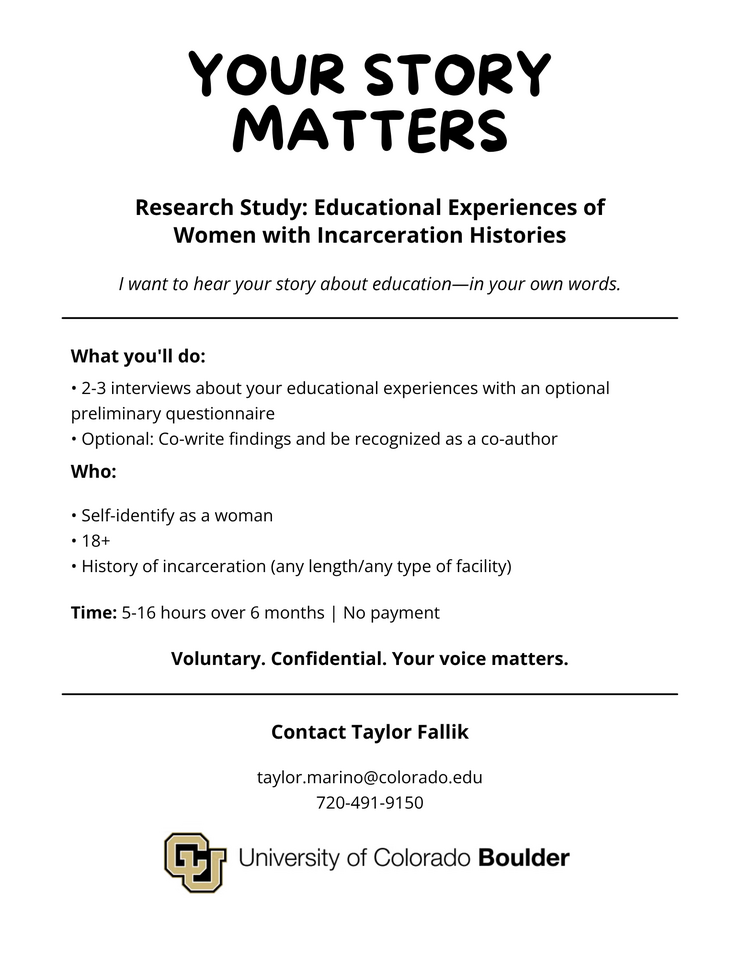
Research Participants Needed: Exploring the Educational Experiences of Women with Incarceration Histories
Hi RCHEP Community,
I'm Taylor Fallik, a doctoral student at the University of Colorado Boulder, and I'm researching the educational experiences of formerly incarcerated women. The purpose of this study is to listen to and learn from women's stories about education across their lives. I'm looking for participants who self-identify as women and are willing to share their stories.
Here's what's involved:
- Phase 1: 2-3 audio-recorded interviews (90-120 minutes each). Tell your story in your own words.
- Phase 2 (optional): ~5 collaborative sessions where we work together to write up findings. You can choose to be recognized as a co-author in publications.
Who can participate:
- Self-identify as a woman
- 18+
- History of incarceration (any length/any type of facility)
- Able to participate in English
- Willing to share stories about your educational experiences
What participants should know:
- Completely voluntary
- Confidential
- No payment for participation
- Total time: about 5-7 hours for interviews, or 12-16 hours if you join the optional collaborative phase, over approximately 6 months
- Participants choose how they're identified: pseudonym, real name, or assigned name
- Interviews take place in person at a location of your choosing or via Zoom
- Sharing your story may be a meaningful opportunity for reflection, and your insights may help improve educational programs and policies
Interested?
Email: taylor.marino@colorado.edu
Phone: 720-491-9150
Thanks for considering sharing your story.
Taylor Fallik
Doctoral Candidate, School of Education
University of Colorado Boulder
Approved by CU Boulder IRB (Protocol #: 26-0323)

Call to HEP programs: share how you maintain ties with alumni
Mount Tamalpais College (MTC) and its research partners at UC Berkeley's Possibility Lab will release a set of field resources on maintaining ties with released students and involving them in research on HEP program outcomes. This is part of a three-year effort to scale programmatic resources (Identifying and Scaling Higher Education in Prison Programmatic Resources: Systems Alignment Initiative), managed by the American Institutes for Research (AIR) in partnership with the Alliance for Higher Education in Prison and Jobs for the Future.
To ensure our resource is responsive to the needs of as many program types as possible, we invite fellow practitioners to complete a 20 minute survey about whether and how they maintain ties with released students, including their efforts to offer post-release services and evaluate student outcomes.
You can access the survey HERE. We would ask for responses by Wednesday, May 13. Thank you for sharing your work!

HEP Research Symposium at 2026 NCHEP
The Cornell Prison Education Program will be hosting a one-day, pre-NCHEP research symposium designed for researchers and practitioners who study or aspire to study higher education in prison.
This day-long event will be held in conjunction with the 2025 NCHEP conference on Wednesday, April 8th, 2026, at the Hilton Cleveland Downtown hotel (connected to the Cleveland Convention Center). The symposium is intended for individuals and organizations engaged in HEP research, including HEP programs' faculty & staff, non-profit organizations, public officials, graduate students, and/or other organizers in the HEP space with a research agenda.
Attendees will participate in breakout discussions on topics related to the possibilities, innovations, and constraints related to data collection, analysis, dissemination, and ethical practice of research on higher education in prison and adjacent issues.
There will be no added registration fee for this HEP research symposium, though of course we encourage everyone to attend the broader NCHEP conference. Space is limited at this one-day symposium, however, so we ask that you use this form [now closed] to express your interest by Dec. 31, 2025.
Please feel free to send any questions to Jenna LaPietra at jl4637@cornell.edu.
We hope to see you in Cleveland.
Research on College in Prison and After Release: Recommendations from Those Who Know Best
Earning a postsecondary credential is a critical pathway to economic success. However, for more than 70 million people with a history of arrest, conviction, or incarceration, involvement in the criminal legal system results in a series of collateral consequences that limit their upward economic mobility. Limited access to education is one of these consequences. For decades, individuals who were incarcerated were not eligible for Pell Grants, a form of federal financial aid to help eligible students pay for college. As a result, higher education in prison was rare.
The July 2023 reinstatement of Pell Grant eligibility increased access to education for thousands of individuals, and a growing number of colleges and universities are offering degree programs to people who are incarcerated. Despite this growth, there are no regulatory bodies to set standards for higher education programs within prisons, and there is a limited understanding of the academic needs of this subset of students. Rigorous evidence detailing students’ educational experiences or examining their long-term educational and employment outcomes is scarce. Instead, most evidence focuses on the effects of these programs on recidivism, or a relapse in criminal behavior, which is often measured by rearrest, reconviction, or reincarceration. Even less systematic evidence exists about how to help people who are pursuing a degree after release.
Within this context, MDRC (Manpower Demonstration Research Corporation) drew on existing research to identify opportunities to build more evidence about best practices to assist students who are pursuing higher education in prison and after release. To inform a research agenda that would be useful to program practitioners, policymakers, researchers, and students, the research team had several dozen conversations with college program staff members, college administrators, academic researchers, state officials, people working to assist individuals while incarcerated or who have recently been released, and students.
This brief offers insights and recommendations from conversations with students and the staff members who work closest to them to inform more responsive research efforts on higher education for students who are incarcerated or have recently been released.
Liminalities Special Issue on Prison Work
Please see the just-released special issue of Liminalities dedicated to Performance Praxis in Carceral Spaces. Edited by Kamran Afary, Greg Langner, and Allen Burnett, the issue centers performance as survival, disruption, and collective imagining across carceral contexts.
Founded in 2005, Liminalities: A Journal of Performance Studies is an open-access, peer-reviewed multimedia publication that addresses three needs in performance studies scholarship and practice: 1) expanding opportunities to share peer-reviewed work, 2) creating a space for the publication of multimedia texts and projects that are difficult or impossible to publish in traditional print venues, and 3) international accessibility and participation.
Liminalities publishes scholarship, aesthetic texts, and media projects that explore, advance, challenge, and celebrate the study of performance as a social, political, philosophical, and aesthetic practice; as a methodology; and as a mode of critique. We welcome the submission of projects addressing performance, the performative, and performativity; performance scripts and aesthetic texts for performance; reviews and criticism of performance work; works about pedagogy and performance; several recurring thematic series; and book reviews. We will consider any form of performance work, and encourage both traditional work and that which challenges the boundaries of performance. We welcome a wide range of performance perspectives, practices, methodologies, contexts, and sites. In addition to texts and images, we publish audio, video, and other digital projects. As of 2024, our goal is to publish 1-2 general issues and 2 or more special issues per year.
The special issue includes:
- Lynn Baker-Nauman, “Who is Godot?” Considering abolitionist theatre & drama therapy.
- Stephen Hartnett, Meghan Cosgrove, and a team of incarcerated and formerly incarcerated scholars including Jacob Carlock, Manuel Sisneros, Sean Mueller, John Burrell, Keean Davis, Kenji Jones, and Taveuan Williams, writing about "Celebrating the Arts and Education in Prison."
- Jadan Janak, “Performing Abolition in the Hold,” an autoethnography of gendered/racialized carceral spaces.
“Troublemaker,” a Cal State Los Angeles multimedia project made by formerly incarcerated grads and faculty. - Claudia Yaghoobi, “Pedagogical Explorations,” on Iranian prison literature & engaged pedagogy.
Participants Needed- Scholar Identity
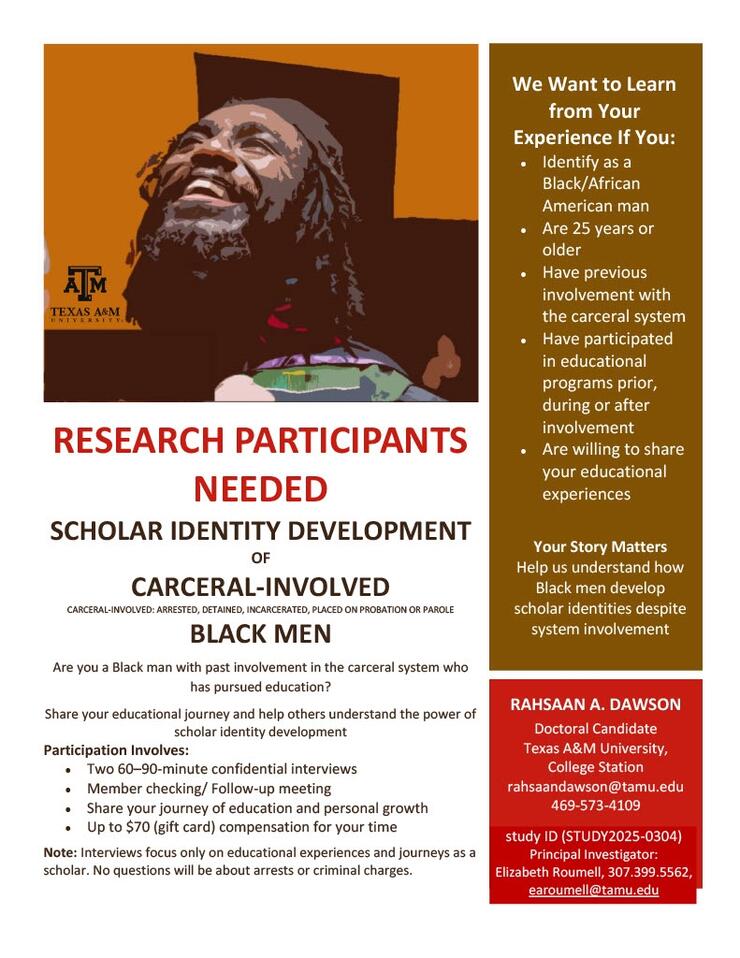
RESEARCH PARTICIPANTS NEEDED
Are you a Black man with past involvement in the carceral system who has pursued education?
Share your educational journey and help others understand the power of scholar identity development
We Want to Learn From Your Experience If You:
- Identify as a Black/African American man
- Are 25 years or older
- Have previous involvement with the carceral system
- Have participated in educational programs prior, during or after involvement
- Are willing to share your educational experiences
Carceral System Involvement- refers to individuals (juvenile/adult) who have had direct involvement with the criminal justice system, including individuals arrested, detained, incarcerated, placed on probation or parole, or have had interaction with law enforcement agencies or legal proceedings. Participants must be at least 3 months post-release.
Scholar Identity – A integration of the individual's academic capabilities with their cultural identity and personal agency. For Black male scholars specifically, it represents the powerful intersection of academic excellence with cultural wealth and masculine identity, manifesting through eight measurable dimensions as a positive self-concept that embraces both intellectual achievement and cultural authenticity.
Participation Involves:
- Two 60–90-minute confidential interviews
- Follow-up meeting
- Share your journey of education and personal growth
- Up to $70 compensation for your time
Note: Interviews focus only on educational experiences and journeys as a scholar. No questions will be asked about arrests or criminal charges.
Your Story Matters Help us understand how Black men develop scholar identities despite system involvement
Contact: Rahsaan A. Dawson Doctoral candidate-researcher
Texas A&M University, College Station
rahsaandawson@tamu.edu, 469-573-4109

Report: Exploring the Landscape of College and Community Reentry Partnerships
On September 30, 2024, Ithaka S+R released a new research report exploring how colleges and community organizations partner to provide reentry services.
The following text was posted on the Ithaka S+R blog to announce publication.
When revised federal Pell Grant regulations went into effect in July of 2023, one of the provisions stipulated that college in prison programs would be obliged to document how they provide reentry services or what organization(s) they partner with to do so. Ithaka S+R’s new report, Exploring the Landscape of College and Community Reentry Partnerships, examines how colleges and community organizations can best partner to deliver effective services for reintegrating students. This report represents the first findings from a multi-year project made possible with funding from ECMC Foundation.
Because there is a large body of scholarship on reentry needs and services, and it can be overwhelming to find a point of entry, we’ve designed this report to help professionals working in colleges, universities, and postsecondary education in prison programs begin to navigate the space. The report provides key takeaways from existing research and highlights from case studies of how postsecondary institutions serve their reintegrating and formerly incarcerated students.
The report also briefly highlights some of the ways that reentry programming and student basic-needs programming overlap—an issue that will be important to consider in future research. Moreover, colleges and universities that serve, or plan to serve, substantial populations of nontraditional students would do well to consider whether their programs are designed, and staff are trained, to reach and serve students impacted by the criminal legal system.
Below we offer key findings. See the full report to explore case studies of the New Jersey Scholarship and Transformative Education in Prisons initiative, the Emerson Prison Initiative, the Washington University in St. Louis Prison Education Project, and the College Gateway Program at Red Rocks Community College.
Key Findings
- The field of providers serving the needs of returning citizens is at once large and disaggregated.
- Contextual factors such as education and employment; family and social support networks; state, local, and charitable service and program offerings; and college support services all influence individual reintegration needs and priorities.
- Reintegration needs, therefore, must be individually assessed and prioritized for each student on a case-by-case basis.
- Colleges employ a variety of partnership structures and service coordination strategies to ensure that reintegrating students have their needs met. While there is no one-size-fits-all solution, it is clear that cross-departmental and cross-organizational collaboration—both within and beyond the university—communication, and coordination are important to aid successful transition to college on the outside.
Needed Specialists for a Challenging Task: Formerly Incarcerated Leaders' Essential Role in Postsecondary Programs in Prison
This research paper examines the development and administration of Hudson Link for Higher Education in Prison, an in-prison college program run and staffed primarily by its own formerly incarcerated graduates. This paper also explores the impact of lived experience on managing and teaching in the program, as well as strategies for academic partners looking to best support interventions led by those who are closest to the problem and, in turn, closest to the solution.
Participation and Outcomes in SUNY College in Prison Programs
This research report offers findings to guide discussions with program administrators, faculty, and formerly incarcerated students on how to improve student access, curriculum choice, retention, and completion. To see how SUNY programs serve people in New York prisons and after they leave incarceration, SUNY’s Office of Higher Education in Prison (SUNY HEP) created a longitudinal data system that links regularly collected student data from the SUNY Institutional Research Information System (SIRIS) and the National Student Clearinghouse with individual-level corrections data from DOCCS. This report, the third in a series (Gais et al., 2019; Gais, Grace, and Wilner, 2021), draws on these data to analyze incarcerated student enrollment, diversity, course subject areas, retention, and completion.
Measuring Reentry Success Beyond Recidivism
This resource brief explores the limitations of recidivism as a measure of reentry success and why other outcomes should be measured. It identifies alternative outcome measures and data sources that reentry programs can use to gauge program effectiveness and participant progress in areas relevant to their respective programs. It also discusses the importance of engaging people with direct reentry experience—either as program participants or staff—in defining meaningful outcome measures.
The Limits of Recidivism: Measuring Success After Prison
This book finds that the current measures of success for individuals released from prison are inadequate. The use of recidivism rates to evaluate post-release success ignores significant research on how and why individuals cease to commit crimes, as well as the important role of structural factors in shaping post-release outcomes. This book highlights the unique and essential insights held by those who have experienced incarceration and proposes that the development and implementation of new measures of post-release success would significantly benefit from active engagement with individuals with this lived experience.
Ensuring the Confidentiality of Participant Data in Reentry Program Operations and Evaluation
This brief from the Evaluation and Sustainability Training and Technical Assistance (ES TTA) team at RTI International and the Center for Court Innovation discusses best practices in protecting and ensuring the confidentiality of participant data.
This brief also provides tips that are relevant to reentry practitioners seeking to protect client data as well as to research partners who are collecting or working with data as part of their evaluation.
Best Practices for Collecting Primary Data From Reentry Populations for Program Evaluation
This resource brief from the Evaluation and Sustainability Training and Technical Assistance (ES TTA) Project at RTI International and the Center for Court Innovation provides guidance on key decisions that need to be made when undertaking primary data collection with reentering populations for reentry program evaluation.
The brief helps evaluators determine what data need to be collected, from whom, when, and how, and summarizes best practices in designing your data collection instrument and developing and implementing data collection protocols.
Surveying Participants to Strengthen Behavioral Health-Criminal Justice Programs
Participant satisfaction surveys help behavioral health-criminal justice programs assess the quality of service being provided and their impact on individual outcomes, as well as help them to determine if there are disparities in program and service delivery. This brief presents important considerations when developing these surveys for people with behavioral health needs in the criminal justice system and ways to integrate survey feedback meaningfully.
Conducting Prison Research With a Racial-Equity Frame
This brief sets forth guiding values and recommendations for grounding prison research in principles of racial equity. These values are intended to help researchers more accurately capture and measure racial biases, and design and conduct research that can identify and disrupt systemic biases.
Participatory Research in Prisons
This brief is part of a larger research agenda for the Prison Research and Innovation Initiative, a five-year effort to leverage research and evidence to shine a much-needed light on prison conditions and pilot strategies to promote the well-being of people who live and work behind bars. The forthcoming research agenda aims to change the national narrative on corrections so that it embodies data-driven transformative innovations for reform and inclusive research approaches to build transparency and accountability for safer and more humane environments for people confined and working behind bars.
Two Regimes of Prison Data Collection
In this column, political scientist and historian Kaneesha Johnson traces the changing form and content of prison data and questions how and why different communities and institutions collect the data they do. In particular, she compares the data gathered about crime and incarceration by the U.S. government with data gathered by incarcerated people and their communities, in part to show that what we measure, collect, and count is always a reflection of the world we are trying to create.
Research Trauma in Incarcerated Spaces: Listening to Incarcerated Women's Narratives
This paper discusses researcher emotional experiences evoked while conducting narrative interviews in a research project that explored the rehabilitation experiences of 18 incarcerated women.
Guidelines for Conducting Meaningful Research in Jails
This resource details key elements of successful strategies in proposing and conducting jail-based research.
Preparing Instructors to Support Students in Prison: Recommendations From the Formerly Incarcerated College Graduates Network (FICGN)
While correctional institutions provide orientation and training sessions to help instructors navigate the logistical and security aspects of teaching in such facilities, these efforts often have limitations. Notably, they tend to lack comprehensive guidance for instructors on effectively engaging students from a diverse range of cultural backgrounds and tailoring their pedagogical approaches to support students as they pursue their studies within the unique context of a correctional facility.
In response to this identified gap, FICGN has collaborated with Jobs for the Future’s Center for Justice & Economic Advancement to support the development of high-quality postsecondary education programs in prisons that pave the way to economic advancement. Together, they have formulated this guidance to offer support to program staff members and instructors. The recommendations presented in this resource are designed to enhance the effectiveness of future orientation and training initiatives. Their aim is to ensure that these programs adequately address the needs of instructors and other key stakeholders who will directly interact with students who are incarcerated for the first time.