Call for Collaboration! Teaching and Learning in HEP Curriculum
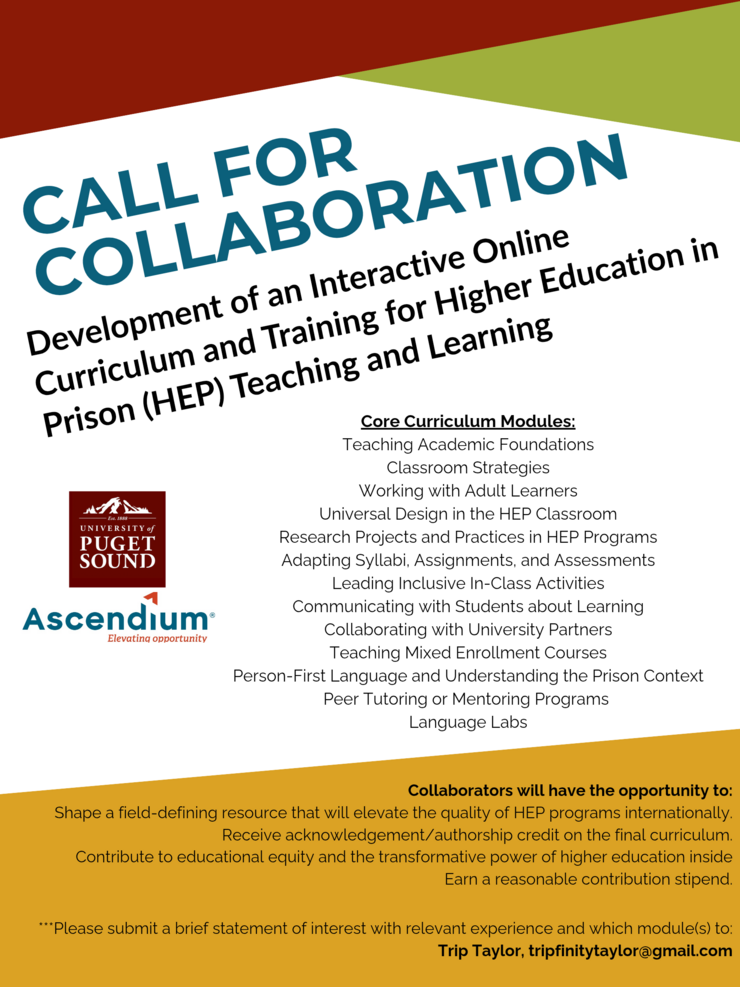
Call for Collaboration:
Development of an Interactive Online Curriculum and Training for Higher Education in Prison (HEP) Teaching and Learning
Who We Are:
Based out of the University of Puget Sound and led by Tanya Erzen, our project recently released the report "Bridging the Divide." This report shares several promising practices designed to help educators and administrators of HEP programs enhance services for their students. We had a dedicated team of 27 individuals, the majority of whom are directly impacted by the justice system, who came together to assess the current landscape of teaching and learning services within the Higher Education in Prison (HEP) field for the report.
The project is now expanding to formalize and implement some of these practices across the field. This next phase is being led by Dr. Erzen with two formerly incarcerated individuals who previously helped develop and lead prison education programs from the inside and are currently working outside in the field: Trip Taylor and Elizabeth Shatswell.
Introduction:
We are seeking passionate educators, instructional designers, scholars, and practitioners committed to excellence and equity in higher education in prison (HEP) programs to collaborate on the development of a comprehensive, interactive, living online curriculum for teaching and learning within prison settings. This crucial resource will equip current and future HEP instructors, university partners, and program staff with the specialized pedagogical knowledge, strategies, and cultural competence necessary to foster rigorous, engaging, and supportive learning environments for incarcerated students.
We are not seeking to reinvent the wheel here. We know that many amazing people on the ground throughout the field have already designed and created remarkable resources along these lines. Our goal is to bring together the resources already out there at individual facilities or programs to develop a robust, living curriculum that can be accessed and utilized by practitioners all over the world working in HEP programs.
This project aims to further bridge the gap between traditional higher education teaching methods and the unique needs, challenges, and opportunities presented by the prison classroom context and learners who have often faced systemic educational barriers.
We are inviting collaborators to join us in designing and developing the following core modules:
Core Curriculum Modules:
Teaching Academic Foundations: Strategies for explicitly teaching fundamental college-level skills, including reading and writing strategies, critical thinking, executive functioning, time management, organizational skills, and navigating the culture of higher education ("learning to be a college student").
Classroom Strategies: Culturally Responsive, Anti-Racist, Trauma-Informed: Developing classroom practices and content delivery that acknowledge and address issues of race, culture, systemic inequality, and the impact of trauma on learning and engagement.
Working with Adult Learners: Exploring principles of andragogy, motivation, prior knowledge, and life experience as assets in the HEP classroom, focusing on effective instructional strategies for adult student success.
Universal Design in the HEP Classroom: Applying Universal Design for Learning (UDL) principles to course design, materials, and instruction to maximize accessibility for all learners. This module will include a specific discussion of disability, accommodation, and access in the carceral context.
Research Projects and Practices in HEP Programs: Guidance on ethical considerations, constraints, and effective strategies for incorporating research methods, information literacy, and project-based learning into the prison classroom, including working with limited resources.
Adapting Syllabi, Assignments, and Assessments: Practical approaches to modifying standard college course materials, learning outcomes, and evaluation methods to be relevant, accessible, and fair within the constraints and realities of the prison environment. Includes low-or-no-tech modifications.
Leading Inclusive In-Class Activities: Techniques for facilitating engaging, equitable, and rigorous classroom interactions, including best practices for leading dynamic class discussions and structuring effective group work.
Communicating with Students about Learning: Strategies for providing constructive, growth-oriented feedback on student work and navigating communication barriers, privacy concerns, and administrative constraints in the HEP context.
Collaborating with University Partners: Best practices for integrating the essential support services of a university—including librarians/research librarians, writing centers, student support staff, and disability services—into HEP programs.
Teaching Mixed Enrollment Courses: Strategies for successfully managing classrooms that include both incarcerated students and non-incarcerated university students (where applicable), ensuring an inclusive and equitable experience for all.
Person-First Language and Understanding the Prison Context: Essential training on using respectful, non-stigmatizing language, understanding the operational and administrative realities of the correctional environment, and navigating security and policy requirements.
Peer Tutoring or Mentoring Programs: Useful tips or guidance on the development of peer tutoring or mentoring within HEP programs.
Language Labs: Innovative curriculum that harnesses immersive methods to transform how students master listening, speaking, reading, and writing skills while deepening their cultural understanding through authentic engagement.
Our Vision:
The final product will be a dynamic, interactive online curriculum and training utilizing multimedia resources, practical case studies, downloadable templates, and opportunities for reflective practice and peer learning. It will be designed for asynchronous access, catering to the schedules of busy educators and staff - but meant to be completed in cohorts for more interactive engagement.
We are seeking collaborators with expertise in:
Higher Education in Prison (HEP) program administration or teaching
Adaptive Instructional Design
Culturally Responsive and Anti-Racist Pedagogy
Trauma-Informed Practices in Education
Universal Design for Learning (UDL) and Disability Services
Adult Learning Theory (Andragogy)
Lived Experience
Benefits of Collaboration:
Collaborators will have the opportunity to:
Shape a field-defining resource that will elevate the quality of HEP programs internationally.
Receive acknowledgement/authorship credit on the final curriculum.
Contribute to educational equity and the transformative power of higher education for incarcerated individuals.
Earn a reasonable contribution stipend.
How to Express Interest:
To express your interest and receive a detailed outline of next steps, please submit a brief statement of interest (no more than 500 words) outlining your relevant experience and the module(s) you are most interested in contributing to tripfinitytaylor@gmail.com by Friday, December 19th, 2025.
We will schedule a Zoom call for mid to late January with those willing and able to contribute to discuss the path forward. We are excited to develop this essential resource with the community!

Research on College in Prison and After Release: Recommendations from Those Who Know Best
Earning a postsecondary credential is a critical pathway to economic success. However, for more than 70 million people with a history of arrest, conviction, or incarceration, involvement in the criminal legal system results in a series of collateral consequences that limit their upward economic mobility. Limited access to education is one of these consequences. For decades, individuals who were incarcerated were not eligible for Pell Grants, a form of federal financial aid to help eligible students pay for college. As a result, higher education in prison was rare.
The July 2023 reinstatement of Pell Grant eligibility increased access to education for thousands of individuals, and a growing number of colleges and universities are offering degree programs to people who are incarcerated. Despite this growth, there are no regulatory bodies to set standards for higher education programs within prisons, and there is a limited understanding of the academic needs of this subset of students. Rigorous evidence detailing students’ educational experiences or examining their long-term educational and employment outcomes is scarce. Instead, most evidence focuses on the effects of these programs on recidivism, or a relapse in criminal behavior, which is often measured by rearrest, reconviction, or reincarceration. Even less systematic evidence exists about how to help people who are pursuing a degree after release.
Within this context, MDRC (Manpower Demonstration Research Corporation) drew on existing research to identify opportunities to build more evidence about best practices to assist students who are pursuing higher education in prison and after release. To inform a research agenda that would be useful to program practitioners, policymakers, researchers, and students, the research team had several dozen conversations with college program staff members, college administrators, academic researchers, state officials, people working to assist individuals while incarcerated or who have recently been released, and students.
This brief offers insights and recommendations from conversations with students and the staff members who work closest to them to inform more responsive research efforts on higher education for students who are incarcerated or have recently been released.

A New Path: Deportation to Honduras
A New Path: Deportation to Honduras is a new guide from the Education Justice Project that provides clear, practical information for individuals facing deportation to Honduras.
The guide covers:
- What to expect upon arrival in Honduras, including how to stay safe;
- Information on housing, employment, education, and more;
- Practical tips for navigating the return and reintegration process;
- A directory of organizations offering support.
Created collaboratively with non-profits and recently deported individuals, our goal is not to facilitate deportation. Rather, we aim to deliver critical information to those facing deportation.
Download the free pdfs (in English and Spanish) at https://reentryillinois.net/a-new-path-individual-chapters/#honduras-deportation-guide
This Honduras deportation guide is part of a larger resource called A New Path: A Guide to the Challenges and Opportunities After Deportation. We are in the process of updating this guide for 2026 and are sharing out individual chapters as they become available. To request copies of the most recent print edition, please fill out this request form.
Recruiting Faculty for our Second Chance Initiative
We are currently accepting applications for our pool of dedicated adjunct instructors who reside in North Carolina or northern South Carolina and are eager to make a meaningful impact through education. This is a unique opportunity to teach in-person at Anson or Sampson Correctional Institutions as part of Campbell University’s Second Chance Initiative — a transformative educational program that offers an associate’s and bachelor’s degree to men and women in two correctional facilities in the state of North Carolina.
If you're passionate about equity, second chances, and teaching in nontraditional environments, we encourage you to apply. Discover more about our mission, impact, and history by visiting: https://aoe.campbell.edu/about/second-chance-initiative/
To be considered for a position in our applicant pool for undergraduate education, applicants must possess a graduate degree (with a minimum of 18 graduate hours from a regionally accredited university) in one or more of the following areas:
Art | Communications | Psychology | English | Sociology | History
All faculty teaching with Adult & Online Education at Campbell University are expected to be highly responsive to student needs and inquiries. Prior to the start of classes, faculty must complete required training focused on both teaching in correctional settings and certification for teaching in adult & online education.
We are currently seeking instructors for courses offered at Sampson and Anson Correctional Institutions, where in-person instruction is held once per week.
- Sampson Correctional class times are either 8:30 AM–11:30 AM or 12:30 PM–3:30 PM
- Anson Correctional class times are either 8:00 AM–10:45 AM or 12:30 PM–3:30 PM
Applicants must be willing to teach in person in at least one of these locations and follow all rules and procedures specific to teaching in a prison environment. Travel reimbursements are available to faculty on a semester basis.
APPLY HERE: https://phg.tbe.taleo.net/phg01/ats/careers/v2/viewRequisition?org=CAMP…
Email Nicole Winget at winget@campbell.edu if you have any questions.

2026-2027 FAFSAs
The 2026-2027 Incarcerated Applicant Form of the FAFSA is now officially available for our Prison Education Program and Second Chance Pell students who are using the paper form.
Go to nasfaa.org/pep to access both the English and Spanish versions of the paper FAFSA.
If your student is completing the online version for 2026-2027, that is accessible at https://studentaid.gov/h/apply-for-aid/fafsa

Join the Womxn’s Higher Education in Prison (WHEP) Consortium online community
I’m excited to share that our Womxn’s Higher Education in Prison (WHEP) Consortium online community is now live on Circle!
This is a space where we can connect across programs, share resources, strategize, and dream big together about the future of higher education in women-designated prisons.
Inside the WHEP Community Hub, you’ll be able to:
- Meet other consortium members and build stronger connections
- Access and share resources in our dedicated Resource Hub
- Stay updated on news, events, and advocacy opportunities
- Collaborate on projects that advance our shared vision of equity, decarceration, and liberation through education
Click here to accept your invitation: https://whep.circle.so/join?invitation_token=c4c8c92d3a63f591979f29a8e8e0a1cef374e6cc-83dc2bb7-2401-448f-9442-97e9d25fadd5
I can’t wait to see you in the WHEP Community Hub and keep building this work together!
In community,
Christina Dawkins
Introducing our new RCHEP feature! - The Calendar
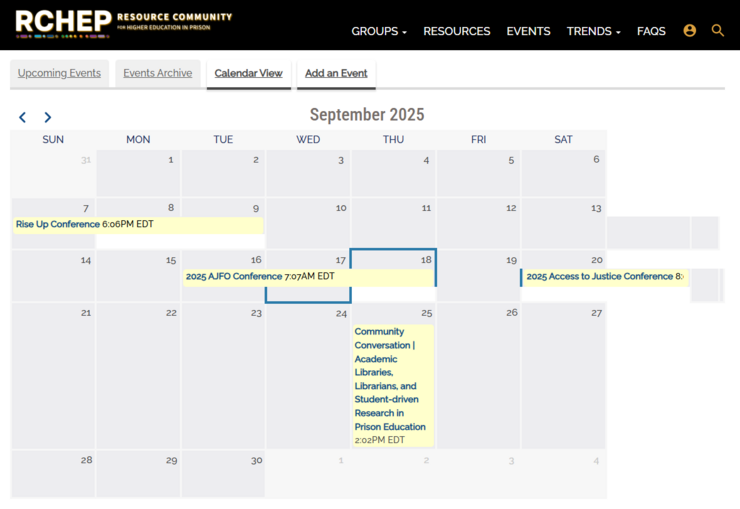
RCHEP now has a new feature - The Calendar!
On the right side of the RCHEP homepage, we've added a list of upcoming events. Events can be added to the list by clicking "Create Event" at the bottom of the list.
Events can also be viewed in other ways:
- To view all upcoming events, click "Events" at the top of the RCHEP webpage.
- To view past events, click "Events Archive" on the Events page.
- To view events in a calendar format, click "Calendar View" on the Events page.
- To add events, click "Add an Event" on the Events page.
Try it out and let us know what you think!
All events are reviewed by an RCHEP admin before publishing. Please make sure to click "Save" on your event posting for it to be reviewed.
Bridging the Divide: Connecting University Teaching & Learning Resources to Higher Education in Prison Programs (HEPS)
Teaching and learning centers—encompassing writing centers, academic support services, tutoring programs, and faculty development hubs—are home to experienced staff committed to inclusive pedagogy, student success, and continuous faculty learning. Yet many of these educational developers are unaware of their university’s own HEP program and the students who could benefit tremendously from their support.
The Freedom Education Project Puget Sound (FEPPS) research team interviewed HEP alumni, faculty, and administrators across the country to better understand some of the challenges and promising practices in the field. They delved into how campus-based teaching and learning supports are (and aren’t) collaborating with their HEPS, and what students in prison still need to receive an equitable education. Inside Bridging the Divide, you’ll find:
A landscape scan of HEP programs, the challenges of the prison learning environment, and the benefits of getting an education in prison.
Analysis and case studies of the barriers and promising practices of integrating university teaching and learning resources with their HEP programs.
A call to action for universities to recognize incarcerated students as full members of the campus community.
Based on in-depth interviews with HEP program faculty, teaching and learning center staff, a national survey of HEP alumni and current students, and a focus group of HEP students, Bridging the Divide reveals that when teaching and learning centers collaborate directly with HEP programs, the results are transformative—for students, faculty, and universities alike.

Fair Chance Hiring for Higher Education Series
We at JFF and the Center for Justice & Economic Advancement listened to feedback about summer not being the best time to run our Fair Chance Hiring for Higher Education Series, so we have rescheduled them for the Fall (Wednesdays in October) and Spring (Wednesdays in February).
Jobs for the Future's Center for Justice and Economic Advancement will be holding their first ever Fair Chance Hiring for Higher Education Series, which focuses on helping higher education institutions build fair chance hiring practices that include justice-impacted talent.
These sessions help unlock the potential of your campus workforce through our two-part Learning Journey designed for HR professionals, campus leaders, faculty, and administrators at colleges and universities to build fair hiring practices that include justice-impacted talent. Participants will gain actionable tools, a strategic roadmap, and a certificate of completion with a LinkedIn badge. The cost to participate is $2,500 for up to five institutional representatives.
- Fall Series (Accelerated Learning): Wednesdays in October, 2:30-4 p.m. EST. The Fall Series offers an accelerated learning experience featuring Fair Chance 101, targeted workshops, a post-assessment, and a hands-on capstone project to help your institution develop a campus-ready implementation plan.
- Spring Series (Deep-Dive Learning): Wednesdays in February 2:30-4 p.m. EST. The Spring Series offers a deeper dive, exploring policy alignment, inclusive recruitment, campus culture-building, safety, and sustainable partnerships.
Use this link to learn more and register for the Fall and Spring series.
NEPEC Workshop: “Approaches to Reentry: Programs and Pathways in New England"
The New England Prison Education Collaborative invites you to the second session in our quarterly virtual workshop series, “Approaches to Reentry: Programs and Pathways in New England.”
Date and Time: Wednesday, September 24, 3-4:15 P.M. EDT
Registration Link: https://events.teams.microsoft.com/event/d9d24622-5520-4e62-a7fb-922384134dd1@b380b9ab-1b37-4852-8ea8-0b3d58a47bed
Location: Microsoft Teams
Event Details: This workshop will spotlight current reentry practices across New England, featuring insights from experts and practitioners actively engaged in the field. Speakers will explore a range of strategies employed through their programs, including pre-release career and educational advising, educational voucher initiatives, community-building efforts, and improving credit mobility.
Expert Panelists:
- Patrick Flynn, Student Services Coordinator, Prison Education Partnership Reentry Specialist at University of Maine at Augusta
- James Monteiro, Executive Director and Founder at Reentry Campus Program
- Billi Dunham, Coordinator of Academic Services at Community College of Vermont
A brief portion of the session will be reserved for open discussion, offering stakeholders and attendees a chance to ask questions, raise concerns, and receive focused technical assistance. We encourage all attendees to come prepared to engage and collaborate.
If you’re unable to attend, we would be grateful if you could engage with and reshare our LinkedIn post on the event to help spread the word, linked here: https://www.linkedin.com/feed/update/urn:li:activity:7366530208536952832
If you have any questions or need additional details, please don’t hesitate to reach out to nepec@nebhe.org. We hope to see you there.
Apply for the Puttkammer Center's new co-creation working group!
The Puttkammer Center for Educational Justice at the Petey Greene Program is launching a new working group focused on academic co-creation with incarcerated scholars. We hope to gather a diverse group of scholars, faculty, and advocates, including and especially those who are impacted by the criminal legal system, to share theories and practices of co-creation that engage incarcerated scholars. We look forward to learning from each other, and we are especially interested in exploring models to:
-
Conduct and publish research in collaboration with incarcerated scholars
-
Engage incarcerated scholars as tutors, instructors, and academic counselors
-
Compensate scholars behind bars
Members will be compensated $1,000 for their participation. We will meet monthly starting in the fall of 2025. If you are interested in joining, please complete this form. For any questions, please contact Nicole Delgadillo (ndelgadillo@peteygreene.org), the Evaluation and Development Manager at the Puttkammer Center for Educational Justice.
We will be accepting applications until September 25th, 2025.
Liminalities Special Issue on Prison Work
Please see the just-released special issue of Liminalities dedicated to Performance Praxis in Carceral Spaces. Edited by Kamran Afary, Greg Langner, and Allen Burnett, the issue centers performance as survival, disruption, and collective imagining across carceral contexts.
Founded in 2005, Liminalities: A Journal of Performance Studies is an open-access, peer-reviewed multimedia publication that addresses three needs in performance studies scholarship and practice: 1) expanding opportunities to share peer-reviewed work, 2) creating a space for the publication of multimedia texts and projects that are difficult or impossible to publish in traditional print venues, and 3) international accessibility and participation.
Liminalities publishes scholarship, aesthetic texts, and media projects that explore, advance, challenge, and celebrate the study of performance as a social, political, philosophical, and aesthetic practice; as a methodology; and as a mode of critique. We welcome the submission of projects addressing performance, the performative, and performativity; performance scripts and aesthetic texts for performance; reviews and criticism of performance work; works about pedagogy and performance; several recurring thematic series; and book reviews. We will consider any form of performance work, and encourage both traditional work and that which challenges the boundaries of performance. We welcome a wide range of performance perspectives, practices, methodologies, contexts, and sites. In addition to texts and images, we publish audio, video, and other digital projects. As of 2024, our goal is to publish 1-2 general issues and 2 or more special issues per year.
The special issue includes:
- Lynn Baker-Nauman, “Who is Godot?” Considering abolitionist theatre & drama therapy.
- Stephen Hartnett, Meghan Cosgrove, and a team of incarcerated and formerly incarcerated scholars including Jacob Carlock, Manuel Sisneros, Sean Mueller, John Burrell, Keean Davis, Kenji Jones, and Taveuan Williams, writing about "Celebrating the Arts and Education in Prison."
- Jadan Janak, “Performing Abolition in the Hold,” an autoethnography of gendered/racialized carceral spaces.
“Troublemaker,” a Cal State Los Angeles multimedia project made by formerly incarcerated grads and faculty. - Claudia Yaghoobi, “Pedagogical Explorations,” on Iranian prison literature & engaged pedagogy.
Teaching & Learning Toolkit: A Research-Based Guide to Building a Culture of Teaching & Learning Excellence
Produced by Achieving the Dream, this Toolkit synthesizes research from the field and stories from our colleges and offers a vast array of work-sheets and planning templates to support college teams in building institutional capacity in teaching and learning. The purpose of this toolkit is for college teams of faculty, faculty/educational developers, Student Affairs professionals, and Academic Affairs leaders to use this resource as they collaborate to change their institutional culture.
Compassionate Integrity Training: A Secular Ethics Approach to Cultivating Personal, Social and Environmental Flourishing
Developed by the Life University Center for Compassion, Integrity, and Secular Ethics (CCISE), this resource manual offers guidelines for practice and trains readers to use a secular ethics approach to cultivating personal, social, and environmental flourishing. Compassionate Integrity Training (CIT) is a multi-part training program that cultivates basic human values as skills for the purpose of increasing individual, social, and environmental flourishing. By covering a range of skills from self-regulation and self-compassion to compassion for others and engagement with complex systems, CIT focuses on and builds toward compassionate integrity: the ability to live one’s life in accordance with one’s values with a recognition of common humanity, our basic orientation to kindness, and reciprocity.
Prison Writing Center Praxis 101 Syllabus
This resource is a syllabus for the Prison Writing Center Praxis I/O course offered at Scripps College by Dr. Kimberley Drake. In this course, students will discuss the theory and practice of an Inside/Out Writing Center, with the goal of establishing and maintaining a Writing Center at CRC. The class will examine academic writing alongside journalism and other forms of nonfiction writing, and students will practice these kinds of writing and all aspects of the writing process as they learn how to give one-on-one feedback in a Writing Center setting. Along the way, students will discuss the politics of the English language, rhetorical strategies in writing and in oral feedback, and writing pedagogy in prisons—including that of the Inside/Out program. Assignments include prewriting, reflective writing, and essay-writing and revision; sentence-level editing; small- group peer workshop; full-class workshop; mock tutorial and debrief; discussion of readings; presentations; and oral presentation skill-building.
Evergreen State College Writing Lab Course Resources
The Evergreen State College developed a writing lab course that provides weekly writing opportunities for students to experiment, observe, or practice. This 4-credit course is a “laboratory” offered in coordination with the BA Colloquium; it features direct instruction along with hands-on practice in a variety of tried-and-true techniques focused on “the 5 Rs”: Reading, Writing, Arithmetic, Resilience, and Rhythm (a.k.a. time management).
University of Puget Sound Instructor Handbook
Developed by the Freedom Education Project Puget Sound (FEPPS), this guide is separated into three sections: Getting to Know the Environment, Pedagogy in Practice, and Curriculum Details & Logistics. The first section of this guide, Getting to Know the Environment, provides an overview of prison infrastructure, terminology, and policies, in addition to how they impact the day-to-day reality and education of our students. The second section, Pedagogy in Practice covers FEPPS Pedagogical principles, as well as foundational knowledge of important educational frameworks: Trauma Responsive Teaching & Universal Design for Learning, that should inform your teaching practice. Throughout these two sections are ‘Implementation Considerations,’ which highlight responsive strategies and best practices FEPPS staff and instructors have utilized to implement pedagogy in practice and be responsive to the challenges of the prison environment. The third section, Curriculum Development Details & Logistics includes details about the classroom, supplies, and logistical processes for developing & executing your course curriculum with FEPPS. Finally, this resource concludes with additional recommendations for continued learning, citations, and an appendix of examples referenced throughout the document.
Preparing Instructors to Support Students in Prison: Recommendations From the Formerly Incarcerated College Graduates Network (FICGN)
With Pell Grant access fully restored as of July 2023, the Formerly Incarcerated College Graduates Network (FICGN) has identified a gap in the existing resources and support available for instructors teaching in a prison setting for the first time. Orientations and trainings offered by correctional institutions tend to lack comprehensive guidance for instructors on effectively engaging students from a diverse range of cultural backgrounds and tailoring their pedagogical approaches to support students as they pursue their studies within the unique context of a correctional facility.
In response to this identified gap, FICGN has collaborated with Jobs for the Future’s (JFF) Center for Justice & Economic Advancement to support the development of high-quality postsecondary education programs in prisons that pave the way to economic advancement. The recommendations presented in this resource are designed to enhance the effectiveness of future orientation and training initiatives.
SUNY HEJI Prison Education Faculty Recruitment Toolkit and Training Resource Guide
Created by SUNY.
This toolkit and guide were created by The State University of New York's (SUNY) Higher Education for the Justice Involved (HEJI) team to help support administrators and professors to best serve students by considering their power and responsibility inside the prison context. The first goal of this document is to help guide programs through developing hiring and training practices that can support quality programming inside the correctional facility. The second goal is to generate a larger conversation about what programs consider to be best practice and how hiring, training, and supporting faculty contribute to the overall goals of building and maintaining quality college in prison programming.
To that end, Part I of this toolkit is designed for program administrators who are developing or overseeing hiring for their college in prison program. It outlines the role of the professor in prison settings and identifies the qualities to look for in candidates applying to teach in prison. Part II, which was created for both faculty and program administrators, speaks to training for faculty once they’ve been hired and ongoing professional development. It offers a set of best practices for faculty who are considering teaching in prison. These materials are created with the acknowledgement that programs need to develop their own unique processes and practices conducive to their campus settings and capacities, and thus there should be expected variation.
The Ohio Prison Education Exchange Project (OPEEP) Instructor Handbook
This manual will help prepare you to teach courses in Ohio’s correctional facilities as part of the Ohio Prison Education Exchange Project (OPEEP). Teaching in prison classrooms is unique and requires specialized training and many new considerations. This manual is meant to offer a guide as you plan your OPEEP courses and navigate the bureaucratic steps on campus and at the prison location where your class will convene.
Also attached to this resource is an OPEEP training slideshow that includes an introduction to OPEEP's mission and vision for the program.