The Reentry group provides a space to discuss all issues related to reentry, from intake onwards. Topics include employment assistance, housing, mental health, legal assistance, parole, and more.
Group Content

Moving Beyond Access: A Curriculum Resource for HEP and Reentry Education
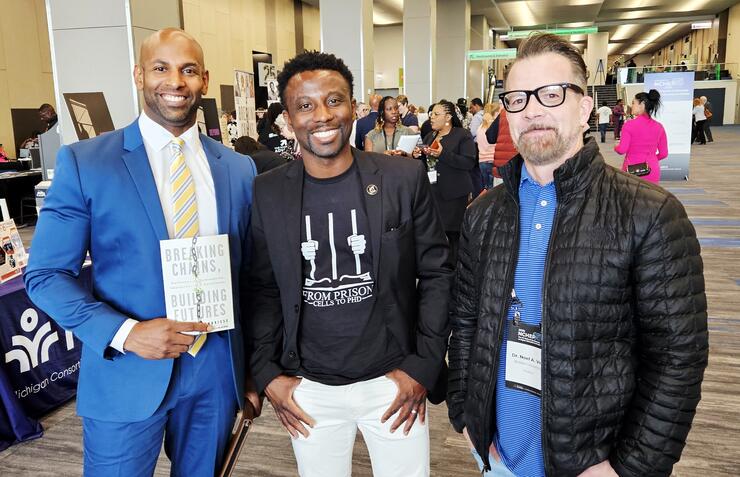
Hi RCHEP Community,
I wanted to share a resource that was developed directly in alignment with the themes and urgency of NCHEP 15, particularly the powerful focus on Beyond Access.
My new book, Breaking Chains, Building Futures: Pathways to Redemption, Education, and Excellence, was intentionally designed as a curriculum-ready resource for higher education in prison programs, reentry initiatives, and educators working with justice-impacted learners. It includes structured modules, reflective prompts, and applied frameworks that can be used in classroom, training, and program development settings.
I’m sharing it here in case it may be useful to colleagues across the field:
- Book: https://a.co/d/06KoeDUr
- Bulk orders: https://share.google/h7w2wVEk7lgk0CQ5s
- Curriculum materials: https://drive.google.com/file/d/1ZzNg5zz6YoPtWi39fe8OexQKS0YhEoD8/view?usp=drivesdk
- Slides: https://drive.google.com/file/d/1AXi0hGM6pBe35ggGTuvEFmBSukGi1gY5/view?usp=drivesdk
For those who attended NCHEP 15 and are already engaging with the book, I would greatly appreciate any reviews or feedback that can help expand its reach and utility across the field.
Grateful for this community and the continued work to move beyond access toward meaningful transformation in higher education in prison.
—
Stanley Andrisse, MBA, PhD
P2P Executive Director | Prison-to-Professionals (P2P)
Tenured Associate Professor, Howard University College of Medicine
Book 1: https://www.amazon.com/Prison-Cells-PhD-Never-Late/dp/1642939404
Book 2: https://www.amazon.com/Breaking-Chains-Building-Futures-Redemption/dp/139432104X

PhD Candidate Doctoral Research
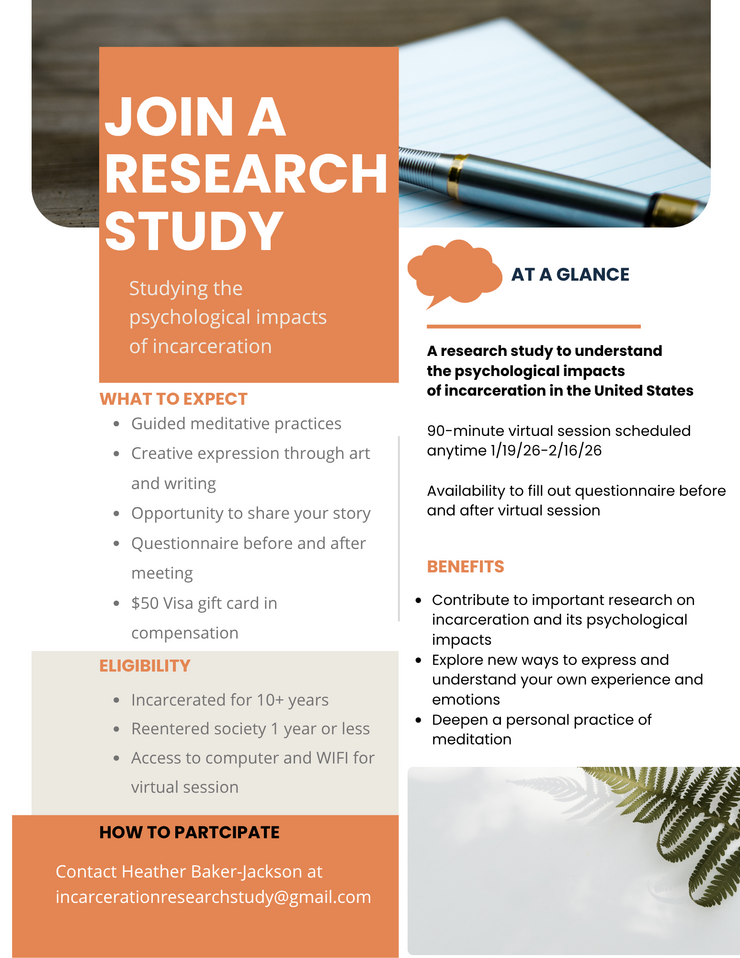
Hello there! I am a doctoral student, currently in the process of completing my dissertation. I'm still in the data-gathering phase, and I'm looking for more participants. I'm studying rehumanization in folks who have just begun their reentry process. My criteria are that they were incarcerated for 10+ years and have reentered within the last 2 years. I have a flyer that I have attached to post. Please reach out if you have any questions! And please feel free to send any potential participants my way!

A New Path: Deportation to Honduras
A New Path: Deportation to Honduras is a new guide from the Education Justice Project that provides clear, practical information for individuals facing deportation to Honduras.
The guide covers:
- What to expect upon arrival in Honduras, including how to stay safe;
- Information on housing, employment, education, and more;
- Practical tips for navigating the return and reintegration process;
- A directory of organizations offering support.
Created collaboratively with non-profits and recently deported individuals, our goal is not to facilitate deportation. Rather, we aim to deliver critical information to those facing deportation.
Download the free pdfs (in English and Spanish) at https://reentryillinois.net/a-new-path-individual-chapters/#honduras-deportation-guide
This Honduras deportation guide is part of a larger resource called A New Path: A Guide to the Challenges and Opportunities After Deportation. We are in the process of updating this guide for 2026 and are sharing out individual chapters as they become available. To request copies of the most recent print edition, please fill out this request form.

Report: Exploring the Landscape of College and Community Reentry Partnerships
On September 30, 2024, Ithaka S+R released a new research report exploring how colleges and community organizations partner to provide reentry services.
The following text was posted on the Ithaka S+R blog to announce publication.
When revised federal Pell Grant regulations went into effect in July of 2023, one of the provisions stipulated that college in prison programs would be obliged to document how they provide reentry services or what organization(s) they partner with to do so. Ithaka S+R’s new report, Exploring the Landscape of College and Community Reentry Partnerships, examines how colleges and community organizations can best partner to deliver effective services for reintegrating students. This report represents the first findings from a multi-year project made possible with funding from ECMC Foundation.
Because there is a large body of scholarship on reentry needs and services, and it can be overwhelming to find a point of entry, we’ve designed this report to help professionals working in colleges, universities, and postsecondary education in prison programs begin to navigate the space. The report provides key takeaways from existing research and highlights from case studies of how postsecondary institutions serve their reintegrating and formerly incarcerated students.
The report also briefly highlights some of the ways that reentry programming and student basic-needs programming overlap—an issue that will be important to consider in future research. Moreover, colleges and universities that serve, or plan to serve, substantial populations of nontraditional students would do well to consider whether their programs are designed, and staff are trained, to reach and serve students impacted by the criminal legal system.
Below we offer key findings. See the full report to explore case studies of the New Jersey Scholarship and Transformative Education in Prisons initiative, the Emerson Prison Initiative, the Washington University in St. Louis Prison Education Project, and the College Gateway Program at Red Rocks Community College.
Key Findings
- The field of providers serving the needs of returning citizens is at once large and disaggregated.
- Contextual factors such as education and employment; family and social support networks; state, local, and charitable service and program offerings; and college support services all influence individual reintegration needs and priorities.
- Reintegration needs, therefore, must be individually assessed and prioritized for each student on a case-by-case basis.
- Colleges employ a variety of partnership structures and service coordination strategies to ensure that reintegrating students have their needs met. While there is no one-size-fits-all solution, it is clear that cross-departmental and cross-organizational collaboration—both within and beyond the university—communication, and coordination are important to aid successful transition to college on the outside.

Participation and Outcomes in SUNY College in Prison Programs
This research report offers findings to guide discussions with program administrators, faculty, and formerly incarcerated students on how to improve student access, curriculum choice, retention, and completion. To see how SUNY programs serve people in New York prisons and after they leave incarceration, SUNY’s Office of Higher Education in Prison (SUNY HEP) created a longitudinal data system that links regularly collected student data from the SUNY Institutional Research Information System (SIRIS) and the National Student Clearinghouse with individual-level corrections data from DOCCS. This report, the third in a series (Gais et al., 2019; Gais, Grace, and Wilner, 2021), draws on these data to analyze incarcerated student enrollment, diversity, course subject areas, retention, and completion.
Measuring Reentry Success Beyond Recidivism
This resource brief explores the limitations of recidivism as a measure of reentry success and why other outcomes should be measured. It identifies alternative outcome measures and data sources that reentry programs can use to gauge program effectiveness and participant progress in areas relevant to their respective programs. It also discusses the importance of engaging people with direct reentry experience—either as program participants or staff—in defining meaningful outcome measures.
The Limits of Recidivism: Measuring Success After Prison
This book finds that the current measures of success for individuals released from prison are inadequate. The use of recidivism rates to evaluate post-release success ignores significant research on how and why individuals cease to commit crimes, as well as the important role of structural factors in shaping post-release outcomes. This book highlights the unique and essential insights held by those who have experienced incarceration and proposes that the development and implementation of new measures of post-release success would significantly benefit from active engagement with individuals with this lived experience.
Ensuring the Confidentiality of Participant Data in Reentry Program Operations and Evaluation
This brief from the Evaluation and Sustainability Training and Technical Assistance (ES TTA) team at RTI International and the Center for Court Innovation discusses best practices in protecting and ensuring the confidentiality of participant data.
This brief also provides tips that are relevant to reentry practitioners seeking to protect client data as well as to research partners who are collecting or working with data as part of their evaluation.
Best Practices for Collecting Primary Data From Reentry Populations for Program Evaluation
This resource brief from the Evaluation and Sustainability Training and Technical Assistance (ES TTA) Project at RTI International and the Center for Court Innovation provides guidance on key decisions that need to be made when undertaking primary data collection with reentering populations for reentry program evaluation.
The brief helps evaluators determine what data need to be collected, from whom, when, and how, and summarizes best practices in designing your data collection instrument and developing and implementing data collection protocols.

Many States Don’t Educate People Sentenced to Life. Now Some Are Coming Home.
This news article from the Washington Post explores how thousands of minors like Yusef Qualls-El, who is highlighted in the article, received sentences of life without parole and entered prison at an age when their peers were going to college or starting their careers. But inside, education is often reserved for those who will soon return to society. As a result, those who were seen as the least likely to get out had the fewest opportunities. The article showcases Yusef Qualls-El's story and his next steps.
From Web to Work: How a Tech Ed Program Helps People Prepare to Leave Prison
This article discusses results published by the Massachusetts Institute of Technology (MIT) and University of Massachusetts Lowell of a two-year study of Brave Behind Bars, MIT's web design program for incarcerated students. The qualitative study evaluated the effects of teaching HTML and JavaScript to incarcerated students, highlighting a notable increase in their self-confidence and digital competencies—key factors in reducing recidivism, or the rate at which people who are released return to prison.
'A Culture Shift' as Colorado Starts Its First Bachelor’s Degree Program at a Women’s Prison
Twenty women at Denver Women's Correctional Facility will be part of a new bachelor's degree program. Students in the program, run by Adams State University, will be able to choose between a sociology or business track. This article describes the program and the reactions of the community.
Open Campus: ‘I Know How to Walk the Walk’ — the Power of Hiring a Formerly Incarcerated Student
This news article from Open Campus features an interview with Donnie Veal, a formerly incarcerated student who recently found himself on the job market.
Open Campus: Job Hunting Isn’t Easy, Especially After Prison. San Quentin Is Trying to Change That.
This news article from Open Campus examines how the San Quentin Rehabilitation Center's Prison to Employment Connection (P2EC) program helps men learn how to put the work they've done inside into context for prospective employers. P2EC is a 14-week job-readiness training program for people who are within one year of a release date or have a scheduled parole board hearing in the next six months. The curriculum includes an assessment to help participants identify possible careers, workshops on identifying strengths and transferable skills, and résumé editing.
Open Campus: The Value of Hands-On Learning in Prison
This news article from Open Campus examines a pre-apprenticeship program in Washington State that introduces incarcerated women to the trades.
Best Practices for Building Post-Release Educational Pathways
These best practices from Jobs for the Future (JFF) can help those involved in prison education build post-release educational pathways for incarcerated students.
For many people who are incarcerated, postsecondary classes offered by the facility in which they’re serving their sentence represent a first step on an educational journey that is likely to continue after they are released—one that could ultimately lead to an industry-recognized credential, an associate’s or bachelor’s degree, or even a master’s degree or a PhD. To facilitate the process of moving from incarceration to on-campus or online classes, colleges and their partners must develop structures and programs that are intentionally designed to support people who are navigating this transition. This brief offers practitioner-informed recommendations from Rutgers University’s New Jersey Scholarship and Transformative Education in Prisons (NJ-STEP) initiative, the higher education in prison program at Des Moines Area Community College (DMACC) in Iowa, and Prison-to-Professionals (P2P) that can help colleges create pathways that honor and support students’ visions for reentering their communities and continuing their educations.
Open Campus: Incarcerated People Are Rarely Hired for Outside Jobs. A Teaching Gig Changed My Life.
This news article from Open Campus is a first-person essay by Leo Hylton, an incarcerated graduate student in Maine who stepped out of the prison gate for the first time in more than a decade for an unusual reason: to meet his students on the campus of Colby College.
Reentry Myth Busters: Veterans' Health Care
The Reentry Myth Busters are a series of fact sheets created by the partner agencies within the Federal Interagency Reentry Council (FIRC) that are intended to clarify existing federal policies that affect individuals who were formerly incarcerated and their families.
This fact sheet addresses the following:
Myth: A veteran with criminal convictions or a history of incarceration is not eligible for VA health care.
Fact: An eligible veteran who is not currently incarcerated can use VA care regardless of any criminal history, including incarceration. Only when an otherwise eligible veteran is currently incarcerated, or in fugitive felon status, is he or she not able to use VA health care.
Reentry Myth Busters: Veterans' Benefits
The Reentry Myth Busters are a series of fact sheets created by the partner agencies within the Federal Interagency Reentry Council (FIRC) that are intended to clarify existing federal policies that affect individuals who were formerly incarcerated and their families.
This fact sheet addresses the following:
Myth: Veterans cannot request to have their VA benefits resumed until they are officially released from incarceration.
Fact: Veterans may inform VA to have their benefits resumed within 30 days or less of their anticipated release date based on evidence from a parole board or other official prison source showing the veteran’s scheduled release date.
Reentry Myth Busters: SNAP Benefits/Mailing Address
The Reentry Myth Busters are a series of fact sheets created by the partner agencies within the Federal Interagency Reentry Council (FIRC) that are intended to clarify existing federal policies that affect individuals who were formerly incarcerated and their families.
This fact sheet addresses the following:
Myth: An individual cannot apply for Supplemental Nutrition Assistance Program (SNAP, formerly the Food Stamp Program) benefits without a mailing address.
Fact: A person can get SNAP benefits even if he or she does not have a mailing address.