What is the state of the field of higher education in prison? What is its future? In this group, you can join conversations that critically reflect on the culture, history, and future of the field.
Topics include, but are not limited to, the culture of HEP programs and classrooms, norms in the field, the history of the field, and its future.
Group Content

Overcoming higher academic language as a barrier to incarcerated students
This work grew from my (Frank Sgro's) experience returning to higher education after serving a long prison sentence. I quickly learned that being capable of college-level work and understanding the language of college were two different things. Academic terms and expectations often assumed knowledge I had never been taught, and asking questions could feel like admitting I did not belong. Through my education and work with Dr. Cailyn Green, I began to see this as a larger barrier for students moving from prison into college. We created this work to identify that barrier and offer educators a practical way to make academic expectations clearer before confusion becomes disengagement. For me, this research is personal and grounded in the hope that students coming behind me will not have to figure out the academic system alone.
Please see the attached pages
Call to HEP programs: share how you maintain ties with alumni
Mount Tamalpais College (MTC) and its research partners at UC Berkeley's Possibility Lab will release a set of field resources on maintaining ties with released students and involving them in research on HEP program outcomes. This is part of a three-year effort to scale programmatic resources (Identifying and Scaling Higher Education in Prison Programmatic Resources: Systems Alignment Initiative), managed by the American Institutes for Research (AIR) in partnership with the Alliance for Higher Education in Prison and Jobs for the Future.
To ensure our resource is responsive to the needs of as many program types as possible, we invite fellow practitioners to complete a 20 minute survey about whether and how they maintain ties with released students, including their efforts to offer post-release services and evaluate student outcomes.
You can access the survey HERE. We would ask for responses by Wednesday, May 13. Thank you for sharing your work!

Moving Beyond Access: A Curriculum Resource for HEP and Reentry Education

Hi RCHEP Community,
I wanted to share a resource that was developed directly in alignment with the themes and urgency of NCHEP 15, particularly the powerful focus on Beyond Access.
My new book, Breaking Chains, Building Futures: Pathways to Redemption, Education, and Excellence, was intentionally designed as a curriculum-ready resource for higher education in prison programs, reentry initiatives, and educators working with justice-impacted learners. It includes structured modules, reflective prompts, and applied frameworks that can be used in classroom, training, and program development settings.
I’m sharing it here in case it may be useful to colleagues across the field:
- Book: https://a.co/d/06KoeDUr
- Bulk orders: https://share.google/h7w2wVEk7lgk0CQ5s
- Curriculum materials: https://drive.google.com/file/d/1ZzNg5zz6YoPtWi39fe8OexQKS0YhEoD8/view?usp=drivesdk
- Slides: https://drive.google.com/file/d/1AXi0hGM6pBe35ggGTuvEFmBSukGi1gY5/view?usp=drivesdk
For those who attended NCHEP 15 and are already engaging with the book, I would greatly appreciate any reviews or feedback that can help expand its reach and utility across the field.
Grateful for this community and the continued work to move beyond access toward meaningful transformation in higher education in prison.
—
Stanley Andrisse, MBA, PhD
P2P Executive Director | Prison-to-Professionals (P2P)
Tenured Associate Professor, Howard University College of Medicine
Book 1: https://www.amazon.com/Prison-Cells-PhD-Never-Late/dp/1642939404
Book 2: https://www.amazon.com/Breaking-Chains-Building-Futures-Redemption/dp/139432104X
New England Reflections on NCHEP 2026
Open to all New Englanders: Join the New England Prison Education Collaborative (NEPEC) team at Whistle Taproom & Venue on Friday, April 10th for a drop-in regional gathering following the formal conclusion of NCHEP 2026. Attendees will reflect on the week’s events, exchange insights and information, and discuss how we want to carry new ideas and practices from the conference back to our region over drinks and light bites.
- What: A drop-in regional gathering with drinks and light appetizers
- When: Friday, April 10, 2026, from 6 to 8 PM ET
- Where: Whistle Taproom & Venue - 818 Huron Rd E, Cleveland, OH 44115
Please feel free to send this invitation to other partners attending NCHEP and working in the New England region. We hope you can make it and look forward to seeing you there!

A New Path: Guatemala
A New Path: Deportation to Guatemala is a new guide from the Education Justice Project that provides clear, practical information for individuals facing deportation to Honduras.
The guide covers:
- What to expect upon arrival in Guatemala, including how to stay safe;
- Information on housing, employment, education, and more;
- Practical tips for navigating the return and reintegration process;
- A directory of organizations offering support.
Created collaboratively with non-profits and recently deported individuals, our goal is not to facilitate deportation. Rather, we aim to deliver critical information to those facing deportation.
Download the free pdfs (in English and Spanish) at https://reentryillinois.net/a-new-path-individual-chapters/#honduras-deportation-guide
This Guatemala deportation guide is part of a larger resource called A New Path: A Guide to the Challenges and Opportunities After Deportation. We are in the process of updating this guide for 2026 and are sharing out individual chapters as they become available. To request copies of the most recent print edition, please fill out this request form.
NEPEC Event: “Navigating the PEP Approval process: Forming Best Interest Determination (BID) Stakeholder Groups "
The New England Prison Education Collaborative invites you to the second session in our quarterly virtual workshop series, “Navigating the PEP Approval process: Forming Best Interest Determination (BID) Stakeholder Groups.”
Date and Time: Wednesday, December 17, 3-4:15 P.M. EDT
Register here: Navigating the PEP Approval Process: Forming Best Interest Determination (BID) Stakeholder Groups | Meeting-Join | Microsoft Teams
Location: Microsoft Teams
Event Details: This workshop will focus on how to form effective Best Interest Determination (BID) groups, a critical component for prison education programs in the region applying for Pell-eligibility. The BID process ensures that programs are not only compliant with federal regulations but also intentionally designed to support the development of educational opportunities that benefit incarcerated learners and support reentry and long-term success. Panelists will discuss how they developed their BID processes and working groups—sharing practical advice, key successes, and the challenges encountered along the way.
Expert Panelists:
- Ruth Delaney, Initiative Director for Unlocking Potential, Vera Institute of Justice
- Laura Roda, Director of Adult Education, Staff Development & Training, State of Maine Department of Corrections
- Tyler Stoldt, Dean of Enrollment Management and Student Services, Washington County Community College
- Thom Anderson, Post-Secondary Education Program Coordinator, Vermont Department of Corrections
A portion of the session will be reserved for open discussion, offering stakeholders and attendees a chance to ask questions, raise concerns, and receive focused technical assistance. We encourage all attendees to come prepared to engage and collaborate.
If you’re unable to attend, we would be grateful if you could engage with and reshare our LinkedIn post on the event to help spread the word.
If you have any questions or need additional details, please don’t hesitate to reach out to nepec@nebhe.org. We hope to see you there.

Reentry Guides are now available on JSTOR Access in Prison
Effective December 5, 2025, the reentry guides created by THEI, EJP, and NYPL are all available and searchable on JSTOR Access in Prison. There is a new link on the home page to these resources, so even if full access to JSTOR isn't available inside, if the JSTOR icon is loaded, anyone using the correctional version of JSTOR can access the materials.
We are seeing close to 2,000 searches daily, which is significant for items that exist outside of the traditional search bar. We are excited to be able to amplify the work being done in reentry, and are hopeful we can expand to more local resources as we test this new feature.

HEP Research Symposium at 2026 NCHEP
The Cornell Prison Education Program will be hosting a one-day, pre-NCHEP research symposium designed for researchers and practitioners who study or aspire to study higher education in prison.
This day-long event will be held in conjunction with the 2025 NCHEP conference on Wednesday, April 8th, 2026, at the Hilton Cleveland Downtown hotel (connected to the Cleveland Convention Center). The symposium is intended for individuals and organizations engaged in HEP research, including HEP programs' faculty & staff, non-profit organizations, public officials, graduate students, and/or other organizers in the HEP space with a research agenda.
Attendees will participate in breakout discussions on topics related to the possibilities, innovations, and constraints related to data collection, analysis, dissemination, and ethical practice of research on higher education in prison and adjacent issues.
There will be no added registration fee for this HEP research symposium, though of course we encourage everyone to attend the broader NCHEP conference. Space is limited at this one-day symposium, however, so we ask that you use this form [now closed] to express your interest by Dec. 31, 2025.
Please feel free to send any questions to Jenna LaPietra at jl4637@cornell.edu.
We hope to see you in Cleveland.

Call for Collaboration! Teaching and Learning in HEP Curriculum
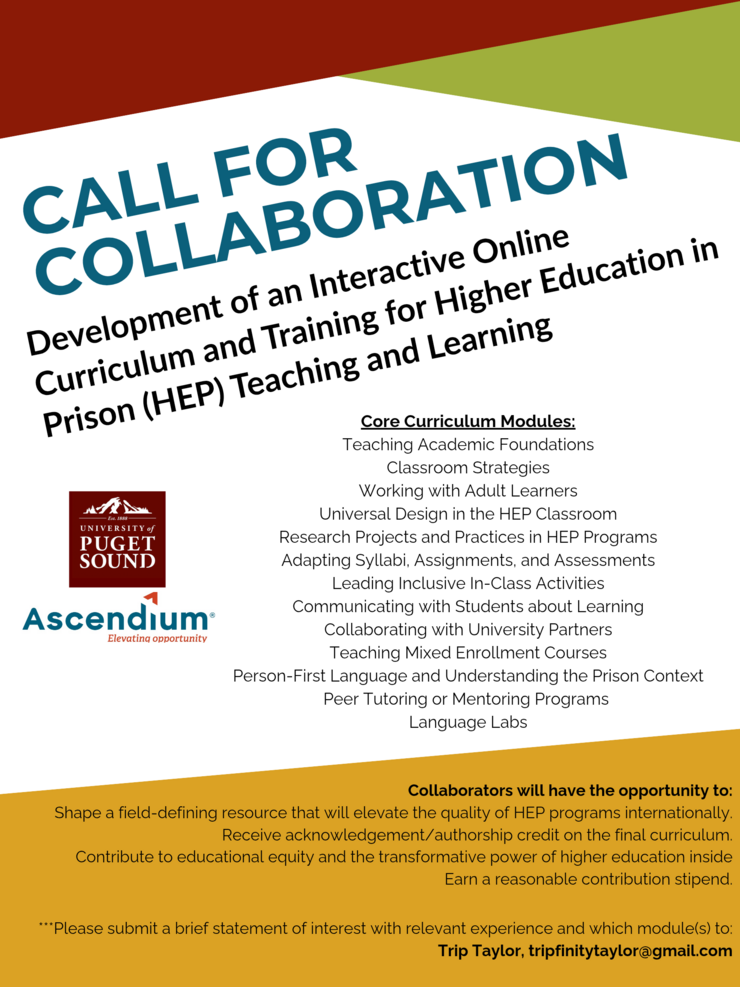
Call for Collaboration:
Development of an Interactive Online Curriculum and Training for Higher Education in Prison (HEP) Teaching and Learning
Who We Are:
Based out of the University of Puget Sound and led by Tanya Erzen, our project recently released the report "Bridging the Divide." This report shares several promising practices designed to help educators and administrators of HEP programs enhance services for their students. We had a dedicated team of 27 individuals, the majority of whom are directly impacted by the justice system, who came together to assess the current landscape of teaching and learning services within the Higher Education in Prison (HEP) field for the report.
The project is now expanding to formalize and implement some of these practices across the field. This next phase is being led by Dr. Erzen with two formerly incarcerated individuals who previously helped develop and lead prison education programs from the inside and are currently working outside in the field: Trip Taylor and Elizabeth Shatswell.
Introduction:
We are seeking passionate educators, instructional designers, scholars, and practitioners committed to excellence and equity in higher education in prison (HEP) programs to collaborate on the development of a comprehensive, interactive, living online curriculum for teaching and learning within prison settings. This crucial resource will equip current and future HEP instructors, university partners, and program staff with the specialized pedagogical knowledge, strategies, and cultural competence necessary to foster rigorous, engaging, and supportive learning environments for incarcerated students.
We are not seeking to reinvent the wheel here. We know that many amazing people on the ground throughout the field have already designed and created remarkable resources along these lines. Our goal is to bring together the resources already out there at individual facilities or programs to develop a robust, living curriculum that can be accessed and utilized by practitioners all over the world working in HEP programs.
This project aims to further bridge the gap between traditional higher education teaching methods and the unique needs, challenges, and opportunities presented by the prison classroom context and learners who have often faced systemic educational barriers.
We are inviting collaborators to join us in designing and developing the following core modules:
Core Curriculum Modules:
Teaching Academic Foundations: Strategies for explicitly teaching fundamental college-level skills, including reading and writing strategies, critical thinking, executive functioning, time management, organizational skills, and navigating the culture of higher education ("learning to be a college student").
Classroom Strategies: Culturally Responsive, Anti-Racist, Trauma-Informed: Developing classroom practices and content delivery that acknowledge and address issues of race, culture, systemic inequality, and the impact of trauma on learning and engagement.
Working with Adult Learners: Exploring principles of andragogy, motivation, prior knowledge, and life experience as assets in the HEP classroom, focusing on effective instructional strategies for adult student success.
Universal Design in the HEP Classroom: Applying Universal Design for Learning (UDL) principles to course design, materials, and instruction to maximize accessibility for all learners. This module will include a specific discussion of disability, accommodation, and access in the carceral context.
Research Projects and Practices in HEP Programs: Guidance on ethical considerations, constraints, and effective strategies for incorporating research methods, information literacy, and project-based learning into the prison classroom, including working with limited resources.
Adapting Syllabi, Assignments, and Assessments: Practical approaches to modifying standard college course materials, learning outcomes, and evaluation methods to be relevant, accessible, and fair within the constraints and realities of the prison environment. Includes low-or-no-tech modifications.
Leading Inclusive In-Class Activities: Techniques for facilitating engaging, equitable, and rigorous classroom interactions, including best practices for leading dynamic class discussions and structuring effective group work.
Communicating with Students about Learning: Strategies for providing constructive, growth-oriented feedback on student work and navigating communication barriers, privacy concerns, and administrative constraints in the HEP context.
Collaborating with University Partners: Best practices for integrating the essential support services of a university—including librarians/research librarians, writing centers, student support staff, and disability services—into HEP programs.
Teaching Mixed Enrollment Courses: Strategies for successfully managing classrooms that include both incarcerated students and non-incarcerated university students (where applicable), ensuring an inclusive and equitable experience for all.
Person-First Language and Understanding the Prison Context: Essential training on using respectful, non-stigmatizing language, understanding the operational and administrative realities of the correctional environment, and navigating security and policy requirements.
Peer Tutoring or Mentoring Programs: Useful tips or guidance on the development of peer tutoring or mentoring within HEP programs.
Language Labs: Innovative curriculum that harnesses immersive methods to transform how students master listening, speaking, reading, and writing skills while deepening their cultural understanding through authentic engagement.
Our Vision:
The final product will be a dynamic, interactive online curriculum and training utilizing multimedia resources, practical case studies, downloadable templates, and opportunities for reflective practice and peer learning. It will be designed for asynchronous access, catering to the schedules of busy educators and staff - but meant to be completed in cohorts for more interactive engagement.
We are seeking collaborators with expertise in:
Higher Education in Prison (HEP) program administration or teaching
Adaptive Instructional Design
Culturally Responsive and Anti-Racist Pedagogy
Trauma-Informed Practices in Education
Universal Design for Learning (UDL) and Disability Services
Adult Learning Theory (Andragogy)
Lived Experience
Benefits of Collaboration:
Collaborators will have the opportunity to:
Shape a field-defining resource that will elevate the quality of HEP programs internationally.
Receive acknowledgement/authorship credit on the final curriculum.
Contribute to educational equity and the transformative power of higher education for incarcerated individuals.
Earn a reasonable contribution stipend.
How to Express Interest:
To express your interest and receive a detailed outline of next steps, please submit a brief statement of interest (no more than 500 words) outlining your relevant experience and the module(s) you are most interested in contributing to tripfinitytaylor@gmail.com by Friday, December 19th, 2025.
We will schedule a Zoom call for mid to late January with those willing and able to contribute to discuss the path forward. We are excited to develop this essential resource with the community!
Bridging the Divide: Connecting University Teaching & Learning Resources to Higher Education in Prison Programs (HEPS)
Teaching and learning centers—encompassing writing centers, academic support services, tutoring programs, and faculty development hubs—are home to experienced staff committed to inclusive pedagogy, student success, and continuous faculty learning. Yet many of these educational developers are unaware of their university’s own HEP program and the students who could benefit tremendously from their support.
The Freedom Education Project Puget Sound (FEPPS) research team interviewed HEP alumni, faculty, and administrators across the country to better understand some of the challenges and promising practices in the field. They delved into how campus-based teaching and learning supports are (and aren’t) collaborating with their HEPS, and what students in prison still need to receive an equitable education. Inside Bridging the Divide, you’ll find:
A landscape scan of HEP programs, the challenges of the prison learning environment, and the benefits of getting an education in prison.
Analysis and case studies of the barriers and promising practices of integrating university teaching and learning resources with their HEP programs.
A call to action for universities to recognize incarcerated students as full members of the campus community.
Based on in-depth interviews with HEP program faculty, teaching and learning center staff, a national survey of HEP alumni and current students, and a focus group of HEP students, Bridging the Divide reveals that when teaching and learning centers collaborate directly with HEP programs, the results are transformative—for students, faculty, and universities alike.
NEPEC Workshop: “Approaches to Reentry: Programs and Pathways in New England"
The New England Prison Education Collaborative invites you to the second session in our quarterly virtual workshop series, “Approaches to Reentry: Programs and Pathways in New England.”
Date and Time: Wednesday, September 24, 3-4:15 P.M. EDT
Registration Link: https://events.teams.microsoft.com/event/d9d24622-5520-4e62-a7fb-922384134dd1@b380b9ab-1b37-4852-8ea8-0b3d58a47bed
Location: Microsoft Teams
Event Details: This workshop will spotlight current reentry practices across New England, featuring insights from experts and practitioners actively engaged in the field. Speakers will explore a range of strategies employed through their programs, including pre-release career and educational advising, educational voucher initiatives, community-building efforts, and improving credit mobility.
Expert Panelists:
- Patrick Flynn, Student Services Coordinator, Prison Education Partnership Reentry Specialist at University of Maine at Augusta
- James Monteiro, Executive Director and Founder at Reentry Campus Program
- Billi Dunham, Coordinator of Academic Services at Community College of Vermont
A brief portion of the session will be reserved for open discussion, offering stakeholders and attendees a chance to ask questions, raise concerns, and receive focused technical assistance. We encourage all attendees to come prepared to engage and collaborate.
If you’re unable to attend, we would be grateful if you could engage with and reshare our LinkedIn post on the event to help spread the word, linked here: https://www.linkedin.com/feed/update/urn:li:activity:7366530208536952832
If you have any questions or need additional details, please don’t hesitate to reach out to nepec@nebhe.org. We hope to see you there.
More than the Diploma: Why a Sense of Belonging is Vital for Incarcerated Students
Becoming an alumnus is about more than just a diploma or a completed program. It's about the memories forged, the friendships made, and the enduring sense of belonging that can enrich a person's life long after graduation. I know this feeling intimately. Though my time on campus was brief, I’ll always be a Colorado Buffalo. That shared identity keeps me connected to a broader network, allows me to support future students, and inspires me to proudly wear my CU gear whenever the Buffs play.
This powerful connection isn't unique to traditional college graduates. Whether it’s a high school, a dance team, a church, or even a professional sports team, humans inherently seek to belong. Psychologists and higher education researchers alike confirm that this sense of connectedness is crucial for long-term mental well-being—as vital, in fact, as the degree itself for college students (Maslow, 1943; Strayhorn, 2012/2019).
With the 2023 renewal of Pell grants for incarcerated learners, higher education in prison (HEP) programs are expanding, bringing this transformative sense of belonging directly into correctional facilities. For individuals behind bars, becoming an alumnus of a HEP program can offer far more than just a degree. It can significantly improve mental health and provide a critical foundation for successful reintegration into society.
Currently, prisons often contend with the negative pull of gang affiliations and other harmful forms of belonging. Even when individuals are incarcerated for years or decades, the fundamental human desire to fit in and be part of something larger than oneself remains. What if we offered a more positive alternative: a sense of belonging derived from an institution focused on education and personal growth? This could fundamentally shift the internal culture of prisons.
Prisons are not disappearing anytime soon, which means we have an opportunity, and a responsibility, to use these institutions to foster positive change. Educating incarcerated individuals costs less than re-incarcerating them. With millions of people already incarcerated, why not use that time to equip them with the tools and support they need to turn their lives around?
Think about it: people proudly wear college gear and cheer on their alma maters for decades. Alumni associations help graduates secure jobs and build networks. Individuals re-entering society from prison desperately need structural support for continued education and employment. A strong sense of belonging is intrinsically linked to sustained mental health, which directly impacts recidivism rates.
That's why we need more HEP programs that fully embrace and cultivate this culture of belonging. This could mean simple things like T-shirts with college logos that students can wear in the recreation yard or during visits. More importantly, it should absolutely include robust alumni associations where graduates can support each other, both pre- and post-release. These programs offer more than just degrees; they offer a lifeline of connection and hope.
This is not out of the question, but it requires a cooperative effort. It means getting buy-in from correctional leadership at each institution. It means the college or university needs to provide systemic support beyond just offering classes. It means valuing the students and listening to their needs. This all-hands-on-deck approach will be well worth the effort, as it will significantly improve the culture within facilities and enhance the readiness of individuals returning to society.
References:
Maslow, A. H. (1943). A theory of human motivation. Psychological Review, 50(4), 370–396.
Strayhorn, T. L. (2012). College students’ sense of belonging: A key to educational success. New York, NY: Routledge.
What are the benefits of higher education in prison and how can those benefits be extended to all the women?
The past few years we have heard about Pell grants that are allowing those in prison to attend college. There are many who do not qualify for the prison programs. Some women do not have a high school education or a GED. In some places, prison rules exclude some women from college programs. For example, Ohio used to have a rule that prisoners had to be within five years of the parole board to attend college.
Here is my question: What benefits are the women in college programs getting and how can those benefits be extended to the women who are not in college? I am presenting on this at ASC in November and I would like to hear what you think. I talked about this with some women at ORW who could not attend the college program and they felt like they were being treated unfairly because they could not attend college. I feel like we have created another stratification layer in the prison with some women getting benefits that others cannot have.
Comments?
NEPEC Event: “Building and Sustaining a Prison Education Program."
The New England Prison Education Collaborative invites you to the second session in our quarterly virtual workshop series, “Building and Sustaining a Prison Education Program.”
Date and Time: Wednesday, June 18, 3-4 P.M. EDT
Registration Link: https://lnkd.in/eEXqe_N7
Location: Microsoft Teams
Event Details: This workshop will bring together a panel of experts to explore strategies for developing and maintaining effective Pell-eligible Prison Education Programs (PEPs). Topics will include building institutional support for PEPs, building strong program provider and Department of Corrections partnerships, an overview of the PEP approval process, and developments related to proposed changes to federal financial aid (including Pell grants) that could affect incarcerated students.
Expert Panelists:
- Ruth Delaney, Initiative Director for Unlocking Potential at Vera Institute of Justice
- Daniel McGloin, Director of the Prison Education Partnership at the University of Maine at Augusta
- Gena Bianco, Dean of the Extension School (RWU EXT) at Roger Williams University
- Leah Maciejewski, Vice President of Academic Affairs at White Mountains Community College
A brief portion of the session will be reserved for open discussion, offering stakeholders and attendees a chance to ask questions, raise concerns, and receive focused technical assistance. We encourage all attendees to come prepared to engage and collaborate.
If you’re unable to attend, we would be grateful if you could engage with and reshare our LinkedIn post on the event to help spread the word.
If you have any questions or need additional details, please don’t hesitate to reach out to nepec@nebhe.org. We hope to see you there.
How to Contact the U.S. Department of Education (Fact Sheet)
The U.S. Department of Education has released a new factsheet that provides general information and instructions on how students who are incarcerated and student loan borrowers can contact the Office of Correctional Education and the Student Loan Ombudsman Office by postal mail.
Mend: A Publication of Project Mend, Syracuse University (2025)
Mend, a publication from Project Mend of Syracuse University, celebrates the lives and creative work of incarcerated and formerly incarcerated people as well as individuals who have been impacted by the criminal justice system. This annual publication showcases writing of all types, including fiction, poetry, and nonfiction. While prospective authors may submit pieces that describe their experiences with incarceration, the publication welcomes contributions on any topic.
The Best Interest Determination (BID) Toolkit: Guidance for Oversight Entities
This Best Interest Determination (BID) Toolkit was created by the Vera Institute of Justice, in partnership with a BID Council and the members of the 2024 Corrections Education Leadership Academy (CELA), to be a resource for corrections agencies to prepare their BID system with all processes, procedures, and stakeholders in place, as necessary, to assess postsecondary institutions offering a PEP, according to federal regulations. To maintain their PEP status, postsecondary institutions must work with their correctional partner, otherwise known as the oversight entity, to complete a program review termed the Best Interest Determination (BID). The final regulations require that the BID must take place, at minimum, within two years of the PEP being approved by the U.S. Department of Education (ED) and must be repeated every time the postsecondary institution renews its Program Participation Agreement or earlier if required by the oversight entity.
This Toolkit is designed to assist oversight entities with meeting the BID requirements, as outlined in 34 CFR
668.241 of the final regulations, ED’s FAQs that outline the BID process in more detail, and referenced in ED’s
optional form, “Best Interest Determination- Prison Education Program.” Some of the specific suggestions
outlined in this Toolkit are not required by regulations; however, based on a review of the regulations, Vera
recommends oversight entities create the following four tools:
- Create a policy describing how the BID will be conducted,
- Develop template reports for postsecondary institutions offering approved PEPs to complete,
- Design a BID feedback template for participating stakeholders to complete, and
- Create a response letter to the postsecondary institution offering the PEP that documents the BID
outcome.

NEPEC to release Accelerator Grants Request for Proposals | Wednesday 4/30/2025
The New England Prison Education Collaborative (NEPEC), led by the New England Board of Higher Education (NEBHE), and funded by Ascendium Education Group, will release the Request for Proposals (RFP) for its inaugural Accelerator Grants on Wednesday, April 30, 2025.
Five Accelerator Grants will be awarded to eligible higher education institutions located across the New England states of Connecticut, Maine, Massachusetts, New Hampshire, Rhode Island, and Vermont to increase Pell-eligible prison education programming in their state.
Grant recipients will develop or expand programs, build partnerships, increase access to Pell funding, and support reentry efforts for students transitioning back to campus and home. Applicants are asked to submit proposals for $100,000 of funding for use over 12 months. Grant applications will be due on Friday, June 6, 2025.
To learn more, access the full RFP, and register for the webinar, visit: https://nebhe.org/higher-education-in-prison/our-work/higher-education-engagement/accelerator-grants-rfp-year-1/.

NASFAA 2nd Annual PEP Convening. Aligning Efforts: Navigating the Intersection of Student Services and Prison Education
Grand Hyatt Washington - Washington, DC
Wednesday, June 4, 3:30 p.m. ET through Saturday, June 7, 2025, 12:00 p.m. ET
Join us this summer in Washington, D.C., for the Second Annual Prison Education Program (PEP) Convening, hosted by The National Association of Student Financial Aid Administrators (NASFAA). This in-person convening will focus on the administration of higher education programs in prison and the critical services they provide to incarcerated students.
Bringing together financial aid administrators (FAAs), PEP administrators, and professionals from other student services roles, this convening will explore strategic and practical approaches to best support college students who are incarcerated.
Over four days, attendees will engage with a diverse group of experts, including practitioners, impacted students who are field experts, educators, correctional oversight leaders, accreditation specialists, researchers, and national leaders in prison education and student services. The program will provide PEP administrators with a deeper understanding of the statutory responsibilities and federal compliance requirements managed by FAAs and other student services professionals. Meanwhile, college student services teams will gain valuable insight into the challenges of working in a prison environment, the extraordinary complexities faced by incarcerated students, and the barriers they encounter when transitioning to campus life after confinement.
Sessions will also cover the PEP application process, organizing successful student orientation sessions, disability services responsibilities, budgets, and how to properly manage data privacy and reporting.
As the approval process for PEPs accelerates, 2025 will be a pivotal year for their introduction and expansion. This convening aims to foster collaboration between those administering PEPs and those overseeing student services, bridging gaps in understanding and strengthening support systems for incarcerated students.
Applications to attend this convening will be available soon. Through the generous support from Ascendium Education Group, selected colleges will receive full coverage for registration and travel costs.
Stay tuned for more details!
NEPEC Event: Conducting a Higher Education in Prison Needs Analysis: Varied Approaches and Perspectives
The New England Prison Education Collaborative is preparing to host the first of our quarterly virtual workshops in March, “Conducting a Higher Education in Prison Needs Analysis: Varied Approaches and Perspectives.”
Date and Time: March 19th, 2025, from 3:00- 4:30 PM EST.
Registration Link: https://lp.constantcontactpages.com/ev/reg/d3dzhr5
Location: Zoom
Event Details
This event aims to equip stakeholders – including Departments of Corrections, State Higher Education Executive Officers, program providers, and leaders with lived experience with the tools and knowledge needed to conduct a needs analysis and gauge barriers to increasing access to higher education in prison and improving student success.
While open to the public, we are structuring these quarterly workshops so that they are particularly relevant to state stakeholders engaged in NEPEC’s state strategic planning initiative, which runs in year-long cycles. This aligns with one of NEPEC’s overarching goals: to support all New England states in developing state strategic plans aimed at expanding the quality and quantity of prison education program portfolios—and, if desired, pathways to vocational education—over the next five years. In this way, our quarterly workshops will serve as capacity-building sessions for states in the region: both those who are currently undergoing our state strategic planning process and those who plan to do so in the future.
Expert Panelists – March 2025
This event will feature the following speakers:
- Haley Shoaf, Co-Founder and Co-Executive Director at Unlocked Labs
- Nathan Barrett, Vice President of Programs and Development at the Coleridge Initiative
- Alex Monday, Researcher, Educational Transformation at Ithaka S+R
- Ess Pokornowski, Program Manager, Justice Initiatives at Ithaka S+R
A substantial portion of the session will be dedicated to open discussion, allowing attendees to ask critical questions and receive targeted technical assistance. We believe this is an essential conversation for advancing higher education in prison and we hope to see you there.
If you’re unable to attend, we would be grateful if you could engage with and reshare our LinkedIn post on the event to help spread the word.
If you have any questions or need additional details, please don’t hesitate to reach out to nepec@nebhe.org. We hope to see you there.